10 Clean Code Principles Every Developer Should Follow
Learn the 10 clean code principles every developer should follow — with real code examples in Python and JavaScript covering DRY, SOLID, KISS, YAGNI, error handling, and more.
There's a quote from software engineer Martin Fowler that every developer should have tattooed somewhere visible:
"Any fool can write code that a computer can understand. Good programmers write code that humans can understand."
Clean code is not about writing clever code. It's not about showing off your knowledge of obscure language features or cramming logic into the fewest possible lines. It's about writing code that your teammates — and future you — can read, understand, and change without wanting to flip a table.
The term was popularised by Robert C. Martin, also known as Uncle Bob, who laid out a comprehensive set of clean code practices covering meaningful names, short functions, clear comments, and consistent formatting. But clean code in 2026 means more than following a book published in 2008. It means writing code that holds up across large teams, AI-assisted development workflows, and codebases that need to evolve fast without accumulating crippling technical debt.
This article covers the 10 clean code principles that matter most — what they mean, why they exist, and how to apply them in practice starting today.
What is clean code, exactly?
Clean code is a codebase you can read, understand, and change without unnecessary complications. Readability means you can scan it easily, recognise what each part represents, and follow how data flows through it. Understandability means the structure matches the behaviour. Changeability means you can safely update or extend it without causing new problems elsewhere.
Those three qualities — readable, understandable, changeable — are the test. If your code fails any one of them, it's not clean, regardless of how well it runs.
Why clean code matters more than ever in 2026
Recent research suggests that AI models struggle more with poorly structured code, making clean code practices essential not only for humans but also for AI-assisted development. As AI code tools become part of everyday engineering workflows — autocomplete, code review assistants, refactoring tools — poorly structured code doesn't just slow down your team. It actively makes your AI tools less effective.
Beyond AI, the business case for clean code is straightforward: messy code accumulates technical debt, slows down new feature development, makes bugs harder to trace, and turns onboarding new engineers into a weeks-long ordeal. Clean code is not idealism. It's economics.
Principle 1: Use meaningful, intention-revealing names
The single easiest improvement most developers can make is choosing better names. Variable names, function names, class names — they are the primary interface between your code and the human reading it.
Bad:
def calc(x, y, z):
    return x * y - z
Good:
def calculate_net_revenue(unit_price, quantity_sold, total_discounts):
    return unit_price * quantity_sold - total_discounts
The second version requires zero comments to understand. The name is the documentation.
Descriptive and meaningful names serve as a form of self-documentation, allowing developers to grasp the purpose and functionality of individual components without extensive comments or documentation.
Rules to follow:
- Variables should describe what they hold, not how they're stored (
userAgenotintA) - Functions should describe what they do (
sendWelcomeEmail, notdoStuff) - Boolean variables should read like questions (
isActive,hasPermission,canRetry) - Avoid abbreviations unless they're universally understood in your domain (
url,id,apiare fine;usrNmis not) - Class names should be nouns; method names should be verbs
If you find yourself writing a comment to explain what a variable or function does, that's a signal that the name isn't good enough. Rename first, comment only when unavoidable.
Principle 2: Functions should do one thing only (Single Responsibility)
The Single Responsibility Principle (SRP) states that a function, class, or module should have exactly one reason to change — meaning it should do exactly one job.
A method called validateUser should only validate user data and not also modify records or trigger external actions. When functions try to do multiple things, they become harder to test, harder to reuse, and much harder to debug.
Bad:
function processOrder(order) {
  // validate the order
  if (!order.items || order.items.length === 0) throw new Error('Empty order');

  // calculate total
  let total = order.items.reduce((sum, item) => sum + item.price, 0);

  // save to database
  db.save({ ...order, total });

  // send confirmation email
  emailService.send(order.userEmail, 'Order confirmed!');
}
Good:
function validateOrder(order) { ... }
function calculateOrderTotal(items) { ... }
function saveOrder(order) { ... }
function sendOrderConfirmation(email) { ... }
Each function can now be tested independently, reused elsewhere, and swapped out when requirements change.
Concise functions and methods that adhere to the Single Responsibility Principle are easier to understand, test, and maintain. By focusing on a single task, developers ensure each function remains cohesive and narrowly scoped, reducing complexity and enhancing readability.
A practical rule: If you can't describe what your function does without using the word "and", it's doing too much. Split it.
Principle 3: Don't Repeat Yourself (DRY)
The DRY principle is simple: every piece of logic should exist in exactly one place. If you find yourself copying and pasting code, you're creating a future bug. The next time that logic needs to change, it will change in one place but not the others — and you'll spend hours hunting down the inconsistency.
Bad:
# In checkout.py
tax = price * 0.075

# In invoice.py
tax = price * 0.075

# In reporting.py
tax = price * 0.075
Good:
# In tax_calculator.py
TAX_RATE = 0.075

def calculate_tax(price):
    return price * TAX_RATE
Now when the tax rate changes, it changes in exactly one place.
The DRY principle advocates for the elimination of redundancy within a codebase by encapsulating reusable logic into modular components. By adhering to this principle, developers minimise code duplication, which reduces the likelihood of inconsistencies and bugs.
Important nuance: DRY is about knowledge, not just code that looks similar. Two pieces of code that happen to look the same but represent different concepts should not be merged just because they're identical today. Merge logic when it represents the same rule — not just the same syntax.
Principle 4: Keep It Simple (KISS)
KISS stands for "Keep It Simple, Stupid." It's a reminder that complexity is almost always the enemy of maintainability. Simple code is not lazy code — it's disciplined code that does exactly what's needed without unnecessary abstraction or indirection.
The temptation to over-engineer is real, especially for experienced developers who can see all the edge cases and future requirements from a mile away. But code written to handle requirements that don't exist yet is debt you're paying before you've even borrowed the money.
Bad:
// A factory factory for generating user greeting strategies
class UserGreetingStrategyFactory {
  createStrategy(type) {
    return StrategyRegistry.getStrategy('greeting', type);
  }
}
Good:
function greetUser(name) {
  return `Hello, ${name}!`;
}
KISS promotes code that is easy to understand, debug, and modify. It values practical results over theoretical purity, acknowledging that the primary goal is to create working, maintainable software.
Ask yourself before every abstraction: "Am I adding this because I need it now, or because I think I might need it later?" If the answer is the latter, don't add it yet.
Principle 5: You Aren't Gonna Need It (YAGNI)
YAGNI is the close cousin of KISS. Where KISS is about keeping existing code simple, YAGNI is about not writing code for hypothetical future requirements.
Every line of code you write has to be read, understood, tested, and maintained. Code that solves a problem that doesn't exist yet is pure cost with zero current benefit.
Common YAGNI violations:
- Building a plugin system before you have more than one plugin
- Adding configuration options for behaviours that are always the same
- Writing generic abstractions for a use case with exactly one concrete implementation
- Storing fields in a database table "in case we need them later"
YAGNI encourages a "just-in-time" approach to development. Instead of trying to predict the future and implementing features you might need, you focus solely on what's required for the current requirements. This significantly reduces wasted development time.
The discipline is: build what you need today. Refactor when the second use case actually arrives. At that point, you'll know exactly what the abstraction needs to do — because you'll have two concrete examples to generalise from.
Principle 6: Write self-documenting code — and comment only when necessary
Comments have a reputation problem. Many developers either over-comment (narrating every line) or refuse to comment anything. Both extremes produce bad codebases.
The goal is code that explains what and why through its structure and naming, with comments reserved for explaining why something non-obvious was done.
Comments that add no value:
# Increment i by 1
i += 1

# Check if user is active
if user.is_active:
Comments that actually help:
# We use a 5-second timeout here because the upstream payment API
# has a known issue where connections hang indefinitely under load.
# See: internal incident report INC-2024-471
response = payment_api.charge(amount, timeout=5)
The first examples explain what the code does — which the code itself already makes clear. The second example explains why a specific, non-obvious decision was made, and links to context that future developers will need.
When comments are genuinely necessary:
- Explaining a counterintuitive decision or workaround
- Documenting public API contracts (parameters, return values, exceptions)
- Warning about known gotchas or edge cases
- Providing legal or licensing notices
If you're commenting because your code is confusing, the fix is to refactor the code — not add more comments.
Principle 7: Handle errors explicitly — never silently swallow them
How your code handles failure says a lot about its quality. Silent failure — catching an exception and doing nothing with it — is one of the most damaging things you can do to a codebase's reliability and debuggability.
Bad:
try:
    result = fetch_user_data(user_id)
except Exception:
    pass  # ignore errors
Good:
try:
    result = fetch_user_data(user_id)
except UserNotFoundError as e:
    logger.warning(f"User {user_id} not found: {e}")
    return None
except NetworkTimeoutError as e:
    logger.error(f"Timeout fetching user {user_id}: {e}")
    raise RetryableError("User data fetch timed out") from e
The second version tells you what went wrong, at what severity, for what input — and either handles it gracefully or surfaces a meaningful error to the caller.
Your production logs should tell a story. Errors that are silently swallowed don't just hide bugs — they hide the bugs that cause your worst production incidents, because by the time the symptoms appear, the root cause has long since vanished.
Clean error handling rules:
- Catch specific exceptions, not broad
ExceptionorErrortypes - Always log with enough context to reproduce the problem (user ID, input values, timestamps)
- Never return
nullwhere an exception is more appropriate - Fail fast and visibly rather than slowly and silently
Principle 8: Write tests — and write them first when you can
In 2026, untested code is considered incomplete code. Tests are not a separate phase of development. They are part of the code. A function without tests is a function whose correctness you're guessing at.
Test-Driven Development (TDD) — writing tests before writing the implementation — forces you to design your code's interface before its internals. This produces smaller, more focused functions with clear inputs and outputs, because code that's hard to test is usually code that's doing too much.
The red-green-refactor cycle:
- Red — write a test for the behaviour you want. It will fail because the code doesn't exist yet.
- Green — write the minimum code needed to make the test pass.
- Refactor — clean up the implementation without changing its behaviour. The test keeps you safe.
Even if you don't practice strict TDD, every function you write should have at least one test covering its core behaviour and one covering its most likely failure mode.
What good tests look like:
- They have descriptive names:
test_calculate_tax_returns_zero_for_zero_pricenottest_1 - They test behaviour, not implementation details
- They are fast, deterministic, and independent of each other
- They can be run by anyone on the team without setup instructions
Principle 9: Practise the Boy Scout Rule — leave code cleaner than you found it
The Boy Scout Rule is simple: whenever you touch a piece of code, leave it slightly better than it was. You don't need to refactor the entire module. Just fix the naming, extract a small function, or remove a dead variable while you're there.
Over time, this habit compounds. Codebases maintained by teams that practise the Boy Scout Rule improve steadily. Codebases where developers touch only what they absolutely must gradually rot under the weight of accumulated shortcuts and inconsistencies.
The Boy Scout Rule means: always find the root cause. Always look for the root cause of a problem. Don't just fix the symptom that's causing the immediate bug — understand why it happened and address the underlying condition. The next developer will thank you.
Practical applications:
- Rename a confusing variable while you're in the same function
- Extract logic into a named helper when you see an opportunity
- Delete commented-out code that's been sitting there for months
- Add a missing test for a function you just had to debug
Small, consistent improvements beat infrequent large refactors every time.
Principle 10: Apply the SOLID principles for scalable design
SOLID is an acronym for five object-oriented design principles that, together, produce code that's modular, extensible, and resistant to the kind of design rot that makes large codebases painful to work in. They're worth understanding individually:
S — Single Responsibility Principle A class should have one reason to change. (Covered in Principle 2 above — it applies to classes too, not just functions.)
O — Open/Closed Principle Software entities should be open for extension but closed for modification. You should be able to add new behaviour without editing existing, tested code. This is typically achieved through interfaces and inheritance.
# Instead of modifying this function every time a new payment method is added:
def process_payment(method, amount):
    if method == 'credit_card':
        ...
    elif method == 'paypal':
        ...

# Use an interface that new payment methods implement:
class PaymentProcessor:
    def process(self, amount): ...

class CreditCardProcessor(PaymentProcessor): ...
class PayPalProcessor(PaymentProcessor): ...
L — Liskov Substitution Principle Subclasses should be substitutable for their parent classes without breaking the system. If you extend a class, its behaviour should remain consistent with what the parent class promised.
I — Interface Segregation Principle No class should be forced to implement interfaces it doesn't use. Prefer several small, specific interfaces over one large, general one.
D — Dependency Inversion Principle High-level modules should not depend on low-level modules — both should depend on abstractions. This is the foundation of dependency injection, which makes code dramatically easier to test and extend.
These five principles — Single Responsibility, Open/Closed, Liskov Substitution, Interface Segregation, and Dependency Inversion — provide a comprehensive framework for creating modular, maintainable software that can scale as requirements evolve.
You don't need to apply all five to every function you write. But understanding them gives you a mental model for identifying the kind of design decisions that, compounded over a codebase, determine whether it ages well or collapses under its own weight.
Common clean code mistakes to avoid
Even experienced developers fall into these traps:
Vague naming — data, info, temp, obj, value are not names. They're placeholders. Replace them.
Functions that grow without bounds — a function that's 200 lines long is doing 10 things, not one. Split it.
Magic numbers — if (status === 3) tells you nothing. if (status === ORDER_STATUS.SHIPPED) tells you everything.
Over-abstraction — creating abstract base classes and factory patterns before you have two concrete use cases is premature complexity. Wait for the second use case.
Commented-out code — if it's not running, delete it. Your version control system is your safety net. Trust it.
Inconsistency — using getUserById in one file and fetchUser in another for the same operation creates friction. Pick a convention and stick to it everywhere.
A practical clean code checklist
Before you submit any pull request, run through this list:
| Check | Question to ask |
|---|---|
| Naming | Do all variables, functions, and classes describe what they are or do? |
| Function size | Does each function do exactly one thing? |
| Duplication | Is any logic repeated in more than one place? |
| Simplicity | Is there any complexity that could be removed without losing functionality? |
| Error handling | Are all failure modes handled explicitly and logged meaningfully? |
| Tests | Does every significant behaviour have at least one test? |
| Comments | Are there any comments that could be replaced with better naming or structure? |
| Boy Scout | Did you leave any code you touched slightly better than you found it? |
Final thoughts
Clean code is a discipline, not a destination. No codebase is perfectly clean — entropy is real, deadlines exist, and requirements change in ways that leave scars. The goal isn't perfection. The goal is a codebase that trends toward clarity over time rather than away from it.
By embracing KISS, SRP, DRY, and YAGNI, teams reduce cognitive load and increase testability, which directly contributes to readable code and maintainable software. When these techniques are practised routinely, the codebase remains adaptable and easier to evolve.
Every principle in this article serves the same underlying goal: make your code easy for the next human — including future you — to understand and work with. That's not a nice-to-have. In a world where AI tools amplify the quality of the code they're working with, where engineering teams scale faster than ever, and where technical debt compounds as brutally as financial debt, clean code is a competitive advantage.
Start with one principle. Apply it consistently for a week. Then add the next. That compounding habit is what separates the codebases that teams love from the ones they dread.
Frequently asked questions
What is clean code in simple terms? Clean code is code that any developer on your team can read, understand, and modify without needing extensive documentation or a lengthy explanation from the original author. It prioritises clarity over cleverness.
What is the most important clean code principle? Most experienced developers point to meaningful naming as the highest-leverage principle — because good names make every other part of the code easier to understand. The Single Responsibility Principle is a close second, since it prevents the kind of tangled functions that make codebases genuinely painful to work in.
Is clean code language-specific? The principles are language-agnostic. Meaningful naming, single responsibility, DRY, and SOLID apply equally to Python, JavaScript, Java, Go, and any other language. The specific conventions — naming style, formatting, idioms — vary by language ecosystem.
How do I convince my team to adopt clean code practices? Lead by example in your own pull requests. Bring it up in code reviews constructively, not critically. Propose a shared style guide or linter configuration that automates the most mechanical checks. Frame it in terms of outcomes your team cares about — faster debugging, easier onboarding, less time fixing regressions.
Does clean code conflict with writing code quickly? Short term, clean code takes slightly more thought. Long term, it's dramatically faster — because you spend less time debugging, less time understanding old code before making changes, and less time fixing bugs caused by tangled logic. Most experienced developers report that clean code habits increase their velocity, not reduce it.
What tools help enforce clean code? Linters (ESLint for JavaScript, Pylint for Python, Checkstyle for Java), static analysis tools (SonarQube, Codacy), and code formatters (Prettier, Black, gofmt) automate many mechanical checks. Code reviews remain the best tool for the judgement calls — naming, design, responsibility boundaries — that tools can't fully evaluate.

Iria Fredrick Victor
Iria Fredrick Victor(aka Fredsazy) is a software developer, DevOps engineer, and entrepreneur. He writes about technology and business—drawing from his experience building systems, managing infrastructure, and shipping products. His work is guided by one question: "What actually works?" Instead of recycling news, Fredsazy tests tools, analyzes research, runs experiments, and shares the results—including the failures. His readers get actionable frameworks backed by real engineering experience, not theory.
Share this article:
Related posts
More from Software
May 27, 2026
224Learn how to write unit tests that actually catch bugs — not just pass. Covers the AAA pattern, behaviour vs implementation testing, edge cases, test doubles, mutation testing, and a pre-commit checklist for writing tests that protect production.
May 22, 2026
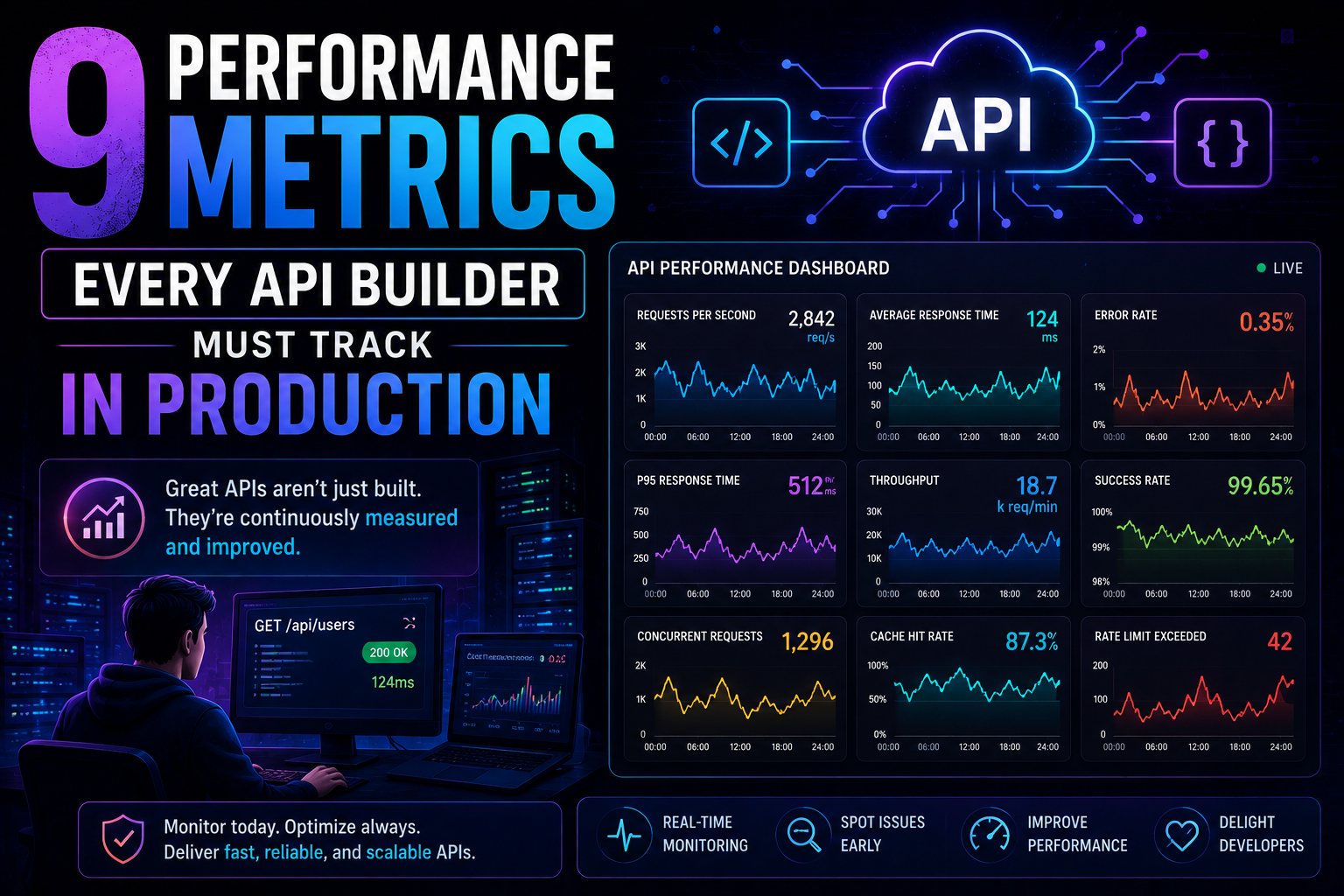
267Latency percentiles. Dependency health. Connection pool saturation. Idempotency success. 9 production metrics every API builder needs – with benchmarks, alert thresholds, and real-world failures prevented.
May 13, 2026
313PostgreSQL vs MongoDB in 2026 — an honest comparison covering benchmarks, data modelling, ACID transactions, scaling, pgvector vs Atlas Vector Search, pricing, and a decision framework for your project.