Python vs Go for Backend Development: A Practical Comparison
Python vs Go for backend development in 2026 — a practical comparison covering performance benchmarks, concurrency, type systems, frameworks, deployment, and which language to choose for your project.
Choosing a backend language is one of the most consequential technical decisions a team makes. It shapes hiring, development velocity, infrastructure cost, and long-term maintainability — and it's a decision that's expensive to reverse once a codebase is established.
In 2026, Python and Go remain two of the most widely discussed options for new backend services. They're both excellent languages. They're both mature, production-battle-tested, and supported by large communities. And they occupy almost opposite positions on the design spectrum: Python optimises for developer speed and ecosystem breadth; Go optimises for runtime speed and operational simplicity.
The data puts the contrast in sharp relief. Go processes JSON API requests at 200,000 requests per second while Python tops out at 25,000. Python commands 92% of the machine learning market while Go holds less than 3%. The average Go developer earns $162,000 per year compared to Python's $148,000. These are not small differences.
This guide gives you a thorough, honest comparison across every dimension that matters in practice: performance, concurrency, type safety, ecosystem, frameworks, deployment, and developer experience. By the end, you'll have a clear decision framework for choosing between the two — and you'll understand why the best engineering teams in 2026 often use both.
A brief history of each language
Python was created by Guido van Rossum in 1991 and is now at version 3.13. It was designed to be readable, expressive, and general-purpose. Its philosophy — summarised in the Zen of Python — prioritises simplicity and explicit over implicit design. Over three decades, it has grown into the world's most widely used programming language, sitting at the top of the TIOBE Index with approximately 23% share driven by its versatility across web development, data science, and AI.
Go — commonly called Golang — was created at Google by Robert Griesemer, Rob Pike, and Ken Thompson and released publicly in 2009. It was designed to solve the problems Google experienced with large-scale C++ and Java codebases: slow compilation, poor concurrency support, and excessive complexity. Go deliberately keeps the language small — just 25 keywords — and trades expressiveness for predictability, speed, and operational simplicity.
Go has climbed steadily from #13 in 2026 to #7 in 2026, fuelled by cloud-native adoption and the microservices trend. Python repositories grew 18% year-over-year in 2025, while Go repositories grew 24%. In absolute numbers Python still dominates, but Go's faster growth rate signals its expanding footprint in backend and infrastructure work.
Performance: how far apart are they really?
Performance is the most-cited reason to choose Go over Python, and the gap is real — particularly for high-throughput, latency-sensitive workloads.
Go is a compiled language that produces native machine code. Python is interpreted, which introduces runtime overhead on every execution. The practical result at scale:
Go APIs maintain sub-50ms p95 latency at 10,000 requests per second. Python's p95 latency climbs to 200ms+ beyond 5,000 requests per second. For p99 latency, Go holds at 0.5–2ms while Python sits at 5–15ms.
If your application requires consistent sub-10ms response times at scale, Go is effectively your only option outside of Rust and C++.
The nuance: For most CRUD APIs, internal tools, and standard web applications handling moderate traffic, Python's performance is completely adequate. FastAPI with async support, for example, performs well enough for the vast majority of real-world workloads. The performance gap becomes decisive in three scenarios:
- High-throughput microservices handling tens of thousands of requests per second
- Real-time systems where latency consistency (not just average) is critical
- Infrastructure tools and daemons that run continuously with predictable resource usage
Memory: Go also has a significant memory advantage. Compiled Go binaries have a small, predictable memory footprint. Python's runtime is heavier, and memory usage tends to grow in ways that are harder to predict and control — a meaningful cost at scale.
Code comparison — a simple HTTP handler:
# Python with FastAPI
from fastapi import FastAPI

app = FastAPI()

@app.get("/users/{user_id}")
async def get_user(user_id: int):
    user = await db.fetch_user(user_id)
    return {"id": user.id, "name": user.name}
// Go with net/http
func getUser(w http.ResponseWriter, r *http.Request) {
    userID := chi.URLParam(r, "userID")
    user, err := db.FetchUser(r.Context(), userID)
    if err != nil {
        http.Error(w, "user not found", http.StatusNotFound)
        return
    }
    json.NewEncoder(w).Encode(user)
}
The Python version is fewer lines and reads more naturally. The Go version is more explicit — and that explicitness is the point.
Concurrency: goroutines vs the GIL
This is the technical dimension where Go has its clearest, most unambiguous advantage over Python.
Python's Global Interpreter Lock (GIL) is a mutex that prevents multiple Python threads from executing Python bytecode simultaneously. It means that even if you spawn 16 threads on a 16-core machine, only one thread executes Python code at any given moment. For CPU-bound work, Python threads provide essentially no parallelism.
Python's answer to the GIL is asyncio — an event loop model for concurrent I/O-bound work. FastAPI and modern async Python frameworks use this effectively. But async Python is cooperative concurrency, not true parallelism — and it requires discipline to use correctly. The wrong use of blocking calls inside an async context can silently stall your entire application.
Go's goroutines are the language's native concurrency primitive. They're lightweight (a few kilobytes of stack to start), managed by the Go runtime, and scheduled efficiently across all available CPU cores. You can spawn millions of goroutines without significant overhead. Communication between them uses channels — a clean, race-condition-resistant pattern for passing data safely.
// Spawning a goroutine — as simple as this
go func() {
    result := processExpensiveTask()
    resultChannel <- result
}()
For backend services that need to handle thousands of concurrent connections, process multiple streams in parallel, or coordinate complex concurrent workflows, Go's concurrency model is substantially more capable and significantly easier to reason about than Python's threading or asyncio patterns.
Type system: dynamic vs static typing
Python is dynamically typed — variables don't have declared types, and type errors surface at runtime rather than compile time. Python 3.5+ introduced optional type hints, and tools like mypy can perform static analysis, but type annotations remain optional and are not enforced at runtime.
The dynamic type system makes Python faster to write — especially for prototyping, scripting, and exploration — but it pushes a category of errors into production that a static type system would catch at build time.
Go is statically typed. Every variable has a declared type, and the compiler enforces type correctness before any code runs. This means a whole class of bugs — type mismatches, nil pointer issues, incorrect function signatures — are caught at compile time rather than discovered by a user in production.
# Python — no type error until runtime
def calculate_total(items):
    return sum(item.price for item in items)

calculate_total("not a list")  # fails at runtime
// Go — type error caught at compile time
func calculateTotal(items []Item) float64 {
    total := 0.0
    for _, item := range items {
        total += item.Price
    }
    return total
}

calculateTotal("not a slice")  // compiler rejects this immediately
For large codebases maintained by multiple developers over long periods, Go's static typing is a significant advantage. It serves as machine-enforced documentation — the function signature tells you exactly what goes in and what comes out. Refactoring is safer because the compiler tells you everywhere something breaks.
For small teams, early-stage products, and data-heavy workflows where shapes of data change frequently, Python's flexibility is a genuine productivity advantage.
Error handling: exceptions vs explicit returns
Python uses exceptions — the EAFP model (Easier to Ask Forgiveness than Permission). Errors propagate up the call stack automatically unless caught. This produces concise code and is familiar to most developers.
try:
    user = get_user(user_id)
    process(user)
except UserNotFoundError:
    return None
except DatabaseError as e:
    logger.error(f"DB error: {e}")
    raise
Go uses explicit error returns — every function that can fail returns an error value as its last return value, and the caller is responsible for checking it.
user, err := getUser(userID)
if err != nil {
    if errors.Is(err, ErrUserNotFound) {
        return nil, nil
    }
    return nil, fmt.Errorf("get user: %w", err)
}
The Go pattern is more verbose — the if err != nil block appears constantly — but it makes error handling explicit and traceable. You always know which operations can fail, and you're forced to decide what to do about each one. In large distributed systems, this clarity around error propagation is genuinely valuable.
The Python approach is more concise but errors can propagate silently across many layers before being caught, making the flow of failures harder to trace in complex systems.
Ecosystem and libraries
This is where the gap between the two languages is most dramatic — and it matters enormously for what you're building.
Python's ecosystem is vast and mature. The Python Package Index (PyPI) hosts over 500,000 packages covering virtually every use case. More critically, Python dominates specific domains that no other language comes close to matching:
- AI and machine learning: PyTorch, TensorFlow, scikit-learn, Keras, Hugging Face Transformers, LangChain — Python commands 92% of the machine learning market. If your backend involves any model training, inference, or data science, Python is not optional — it's the only practical choice
- Data processing: Pandas, NumPy, Polars, Dask, Apache Spark (PySpark)
- Web frameworks: Django (full-featured, batteries-included), Flask (minimal, flexible), FastAPI (modern, async, auto-documented)
- Scientific computing: SciPy, SymPy, Matplotlib, Seaborn
Go's ecosystem is smaller but growing fast. Its standard library is unusually comprehensive — networking, HTTP, JSON, cryptography, testing, and concurrency tools are all built in and high quality. Third-party packages are concentrated in the areas where Go is most used:
- Web frameworks: Gin, Echo, Fiber, Chi (all fast and minimal)
- gRPC and protocol buffers: First-class support, widely used in microservices
- Infrastructure tooling: Docker, Kubernetes, Terraform, Prometheus, and most cloud-native tools are written in Go
- Database drivers: Well-maintained drivers for PostgreSQL, MySQL, Redis, MongoDB, and more
The ecosystem limitation is real: if you need to call a specialised ML library, process genomic data, or work with scientific computing tooling, Go simply doesn't have what Python has.
Web frameworks comparison
| Framework | Language | Philosophy | Best for |
|---|---|---|---|
| FastAPI | Python | Modern, async, type-hinted | REST APIs with auto docs, ML endpoints |
| Django | Python | Full-featured, batteries-included | Full web apps, admin interfaces, CMS |
| Flask | Python | Minimal, flexible | Small services, simple APIs |
| Gin | Go | Fast, minimal | High-throughput REST APIs |
| Echo | Go | Clean, middleware-rich | REST APIs with complex routing |
| Fiber | Go | Express-inspired, ultra-fast | Performance-critical services |
| Chi | Go | Lightweight, idiomatic | Microservices, composable routing |
FastAPI deserves special mention in 2026. It brings Python close to Go's ergonomics for API development — automatic OpenAPI documentation, Pydantic validation, async support, and Python type hints as the primary interface. For teams that want Python's productivity and ecosystem with a modern, high-quality API framework, FastAPI is the standard choice.
Development speed and learning curve
The 2025 Stack Overflow Developer Survey found that developers complete prototypes 2.4x faster in Python than in Go. Python requires roughly 30–40% fewer lines of code for equivalent functionality.
This is not a small advantage. For early-stage products where validating an idea quickly matters more than runtime performance, for internal tools where developer time is the constraint, and for projects where the team already knows Python well, this productivity gap is decisive.
Go has only 25 keywords and a very small surface area. However, new developers must immediately grapple with static typing, explicit error handling, pointers, interfaces, and goroutine synchronisation. The payoff is that once you learn Go, there is not much more to learn — the language deliberately avoids adding features, so a Go codebase written in 2020 looks nearly identical to one written in 2026.
Python's learning curve is gentler at the start but longer in total. The language surface area is large, the ecosystem choices are many, and environment management — virtualenvs, pip, poetry, pipx, conda — adds friction that Go avoids entirely.
Deployment and operations
Go's deployment story is one of its strongest selling points. Go compiles to a single static binary with no external runtime dependencies. To deploy a Go service, you copy one file. Docker images can be as small as a few megabytes using a scratch base. Startup time is measured in milliseconds.
# Go Dockerfile — minimal and fast
FROM golang:1.22 AS builder
WORKDIR /app
COPY . .
RUN CGO_ENABLED=0 go build -o server .

FROM scratch
COPY --from=builder /app/server .
CMD ["/server"]
Python requires the Python runtime, all installed dependencies, and careful management of versions and environment state. Docker images are typically much larger (often 200MB+ even with optimisation), startup time is slower, and dependency conflicts are a real and recurring operational challenge.
For cloud-native environments running many small services, Go's operational simplicity and lower memory footprint translate directly to lower infrastructure cost. A Go microservice handling the same workload as a Python service typically uses significantly less memory and CPU — which compounds at scale.
The AI infrastructure pattern in 2026
One of the most significant architectural trends in 2026 is the Python + Go hybrid, where each language is used for what it does best within the same system.
Many AI serving systems use Go for the API layer while keeping Python for model training and inference. The inference serving layer at scale often uses Go for request routing, load balancing, and connection management, while Python handles the actual model computation via libraries like vLLM and TGI. This hybrid architecture is increasingly common at companies like Cloudflare, which uses Go for its Workers AI routing layer with Python-based model serving behind it.
This pattern reflects the mature understanding that the choice between Python and Go doesn't have to be all-or-nothing. The languages complement each other: Python for the ML work and data-heavy logic, Go for the high-throughput, latency-sensitive infrastructure layer that routes, authenticates, and orchestrates requests.
Side-by-side comparison table
| Dimension | Python | Go |
|---|---|---|
| Performance (throughput) | ~25,000 req/sec | ~200,000 req/sec |
| p99 latency | 5–15ms at scale | 0.5–2ms at scale |
| Concurrency model | asyncio (cooperative) / GIL-limited threads | Goroutines (true parallelism) |
| Type system | Dynamic (optional hints) | Static (enforced at compile time) |
| Error handling | Exceptions | Explicit return values |
| Learning curve | Gentle start, long tail | Steeper start, flat after basics |
| Prototype speed | 2.4x faster than Go | Slower to prototype |
| Lines of code | 30–40% fewer | More verbose |
| Deployment | Runtime + dependencies | Single static binary |
| Memory usage | Higher | Significantly lower |
| Docker image size | 200MB+ | As small as 5–10MB |
| AI/ML ecosystem | Dominant (92% market share) | Minimal |
| Cloud-native tooling | Good | Excellent (Docker, K8s, Terraform) |
| Average developer salary | $148,000/year | $162,000/year |
| Developer availability | Very high (Python #1 language) | Growing (Go #7, rising) |
| Language stability | Stable | Very stable (minimal churn) |
Which should you choose?
Choose Python if:
- Your application involves AI, machine learning, data science, or heavy data processing — Python is not just a preference here, it's the ecosystem requirement
- Development speed and rapid iteration are the primary constraint — early-stage startups, MVPs, and internal tools
- Your team is primarily Python-experienced and hiring Python developers in your market is easier
- You're building web applications that need a rich admin interface, ORM, or content management system (Django is unmatched)
- Your API endpoints are moderate-traffic and don't require sub-10ms p99 latency at thousands of concurrent requests
- You're scripting, automating, or building data pipelines
Choose Go if:
- You're building high-throughput microservices that need to handle tens of thousands of requests per second with consistent, predictable latency
- Your system requires true parallelism — real-time data processing, streaming, concurrent pipeline coordination
- You're building infrastructure tooling, CLIs, daemons, or cloud-native services (the cloud-native ecosystem is Go-native)
- Operational simplicity matters — small Docker images, fast startup, low memory consumption, single binary deployment
- You're building a system that will be maintained by a large team over many years, where Go's static typing and explicit error handling pay long-term dividends
- You're hiring developers who will value Go's salary premium and the smaller, more specialised talent pool
Consider both if:
- You're building an AI-powered product with high-throughput requirements — use Python for the ML layer and Go for the API and routing infrastructure
- You have different services with different performance requirements — no rule says your entire backend must be one language
- You're already running a Python service but specific endpoints are becoming performance bottlenecks — migrating those specific services to Go is a well-worn path
What experienced engineers say
The developers who have used both languages extensively tend to land in the same place. Python is easier for prototyping and MVP development, while Go usually requires stronger engineering expertise earlier in the process.
In 2026, both languages are thriving. Python continues to dominate AI/ML and rapid development. Go continues to dominate cloud infrastructure and high-performance services. Many of the best engineering organisations use both, choosing the right tool for each job.
The mistake to avoid is treating this as a tribal choice rather than a technical one. Neither language is universally superior. The question is which one is better suited to your specific workload, team composition, and growth trajectory — and the honest answer to that question is often "it depends, here's how to decide."
Frequently asked questions
Is Go faster than Python? Yes, significantly. Go is a compiled language that produces native machine code, while Python is interpreted. Go handles approximately 200,000 JSON API requests per second compared to Python's 25,000, and maintains sub-2ms p99 latency at scale where Python reaches 5–15ms. For most standard web applications with moderate traffic, Python's performance is adequate — but for high-throughput, latency-sensitive systems, Go is the clear choice.
Is Python or Go better for building APIs? It depends on your performance requirements and ecosystem needs. Python with FastAPI is an excellent choice for most APIs — it's fast to develop, produces automatic documentation, and integrates seamlessly with databases and third-party services. Go with Gin or Echo is the right choice when you need high throughput, low latency, or operational simplicity in a microservices environment.
Can Go replace Python for AI and machine learning? Not in 2026. Python commands 92% of the machine learning market because of its unmatched ecosystem — PyTorch, TensorFlow, scikit-learn, Hugging Face, LangChain, and thousands of specialised libraries have no meaningful Go equivalents. Go's role in AI is in the infrastructure layer — API gateways, request routing, and orchestration — not in model training or inference.
Which language is easier to learn — Python or Go? Python is significantly easier for beginners. Its syntax is readable, its error messages are helpful, and you can build working programs quickly. Go has a steeper initial curve — you need to understand static typing, explicit error handling, and goroutines before you're productive. However, Go's deliberately small surface area means that once you learn it, there isn't much more to learn. A Python developer faces ongoing learning from the expanding language and ecosystem.
Which pays better — Python or Go developers? Go developers earn slightly more on average — approximately $162,000 per year compared to $148,000 for Python developers, according to 2026 data. This likely reflects Go's smaller talent pool and its concentration in higher-value infrastructure and backend roles. Python developers benefit from a much larger job market with significantly more positions available.
Should I learn Python or Go in 2026? If you're early in your career or want the widest range of opportunities — including AI, data science, web development, and automation — Python is the better starting point. If you already know Python or another language and want to specialise in high-performance backend systems, cloud infrastructure, or microservices architecture, Go is a high-value addition that opens a different set of senior engineering roles.
Is it common to use Python and Go together? Increasingly, yes. The Python + Go hybrid is a standard pattern in high-scale AI-powered systems — Python for the ML and data layer, Go for the high-throughput API and routing infrastructure. Many engineering organisations that operate at scale run both, assigning each language to the service types where it excels.

Iria Fredrick Victor
Iria Fredrick Victor(aka Fredsazy) is a software developer, DevOps engineer, and entrepreneur. He writes about technology and business—drawing from his experience building systems, managing infrastructure, and shipping products. His work is guided by one question: "What actually works?" Instead of recycling news, Fredsazy tests tools, analyzes research, runs experiments, and shares the results—including the failures. His readers get actionable frameworks backed by real engineering experience, not theory.
Share this article:
Related posts
More from Software
May 27, 2026
227Learn how to write unit tests that actually catch bugs — not just pass. Covers the AAA pattern, behaviour vs implementation testing, edge cases, test doubles, mutation testing, and a pre-commit checklist for writing tests that protect production.
May 22, 2026
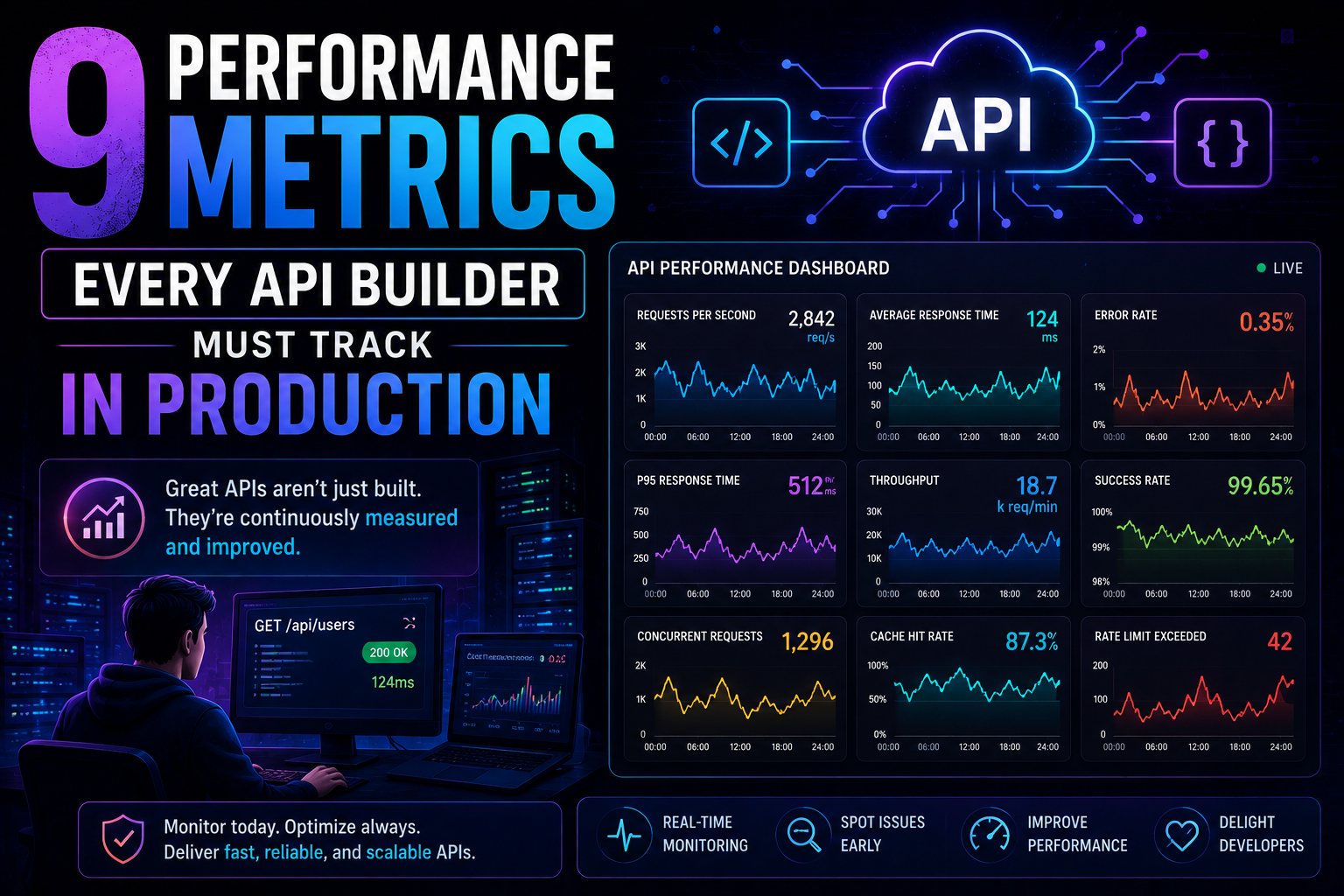
271Latency percentiles. Dependency health. Connection pool saturation. Idempotency success. 9 production metrics every API builder needs – with benchmarks, alert thresholds, and real-world failures prevented.
May 13, 2026
318PostgreSQL vs MongoDB in 2026 — an honest comparison covering benchmarks, data modelling, ACID transactions, scaling, pgvector vs Atlas Vector Search, pricing, and a decision framework for your project.