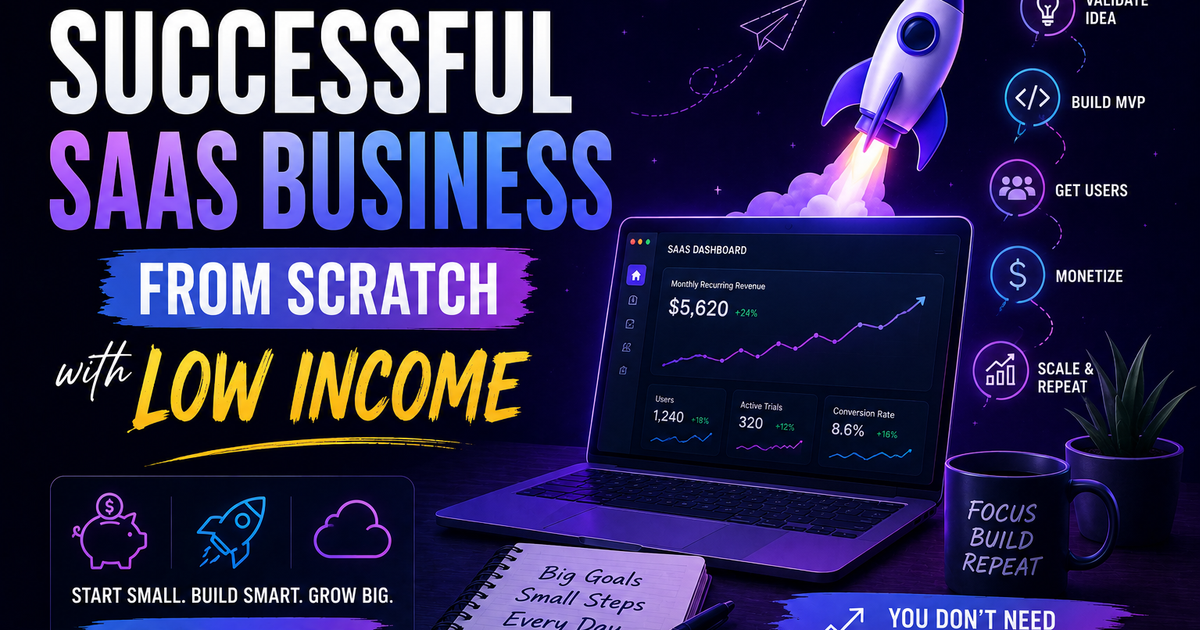
How to Build a Successful SaaS Business from Scratch with Low Income
You do not need $50k to start a SaaS business. Here is a step-by-step guide to building from scratch with low income: idea validation, MVP on $30/month, first 10 customers without paid ads, and the realistic path to $5k MRR.
You do not need $50,000 to start a SaaS company.
I am going to say that again because the internet has lied to you. You do not need a team of developers. You do not need a polished office. You do not need a marketing budget that would feed a small village.
What you need is time, focus, and the willingness to build something so painfully specific that no one else wants to build it.
I have watched founders bootstrap SaaS businesses to $10k, $50k, and even $100k monthly recurring revenue from a laptop in a shared apartment. One of them started with $47 in his bank account and a free Stripe account. Another built the first version of her product during nights and weekends while working a full-time call centre job.
The common thread was never money. It was resourcefulness.
This guide is for you if you have low income, no investors, and a burning desire to build something that pays you every month. I will walk you through exactly how to choose the right idea, build a first version for almost nothing, get your first paying customers without a marketing budget, and grow without burning out.
Let me be honest upfront: this path is slower than raising money. You will not grow at 20% month over month. You will not be on TechCrunch. But you also will not give away 20% of your company for money you could have saved by being smarter.
Here is how to do it.
The fundamental mindset shift: time is your only real asset
When you have no money, you have one thing in abundance that funded founders waste: time.
A funded founder pays $15,000 for a landing page designer. You spend three weekends learning Framer or Carrd and build it yourself.
A funded founder hires a marketing agency to run ads. You spend evenings writing helpful answers on Reddit and Twitter until people notice you.
A funded founder pays a sales team to prospect. You send 50 personalised emails to potential customers from your Gmail account.
This is not romanticism. This is the arithmetic of bootstrapping. Every dollar you do not spend is a dollar you do not need to earn. Every skill you learn yourself is a skill you never need to hire for.
The bootstrapper's equation:
Success = (Time invested × Focus) - (Money spent on things you could have done yourself)
Your job is not to outspend competitors. Your job is to outlearn, outwork, and outlast them.
Step 1: Find a problem that is painful, narrow, and ignored
Most first-time founders make the same mistake. They try to build something for "everyone." A project management tool. A CRM. An AI writing assistant.
These markets are owned by giants with millions of dollars and hundreds of engineers. You will not beat Asana. You will not beat HubSpot. You will not beat Jasper.
Your advantage is smallness. You can serve a niche so specific that the giants ignore it.
How to find your niche with zero budget:
| Method | How it works | Example |
|---|---|---|
| Your own pain | What do you do repeatedly that feels like a waste of time? | A designer who kept reformatting invoices built a template generator |
| Small community problems | Spend 2 hours reading Reddit, LinkedIn, or niche Facebook groups. What do people complain about? | "I wish there was a tool to X" is a goldmine |
| Manual work being done today | Find something people do in spreadsheets or with copy-paste | A founder built a tool that automated onboarding checklists for agencies |
| Complementary to existing tools | What is missing from popular software? Build the missing piece | A tool that exports Asana tasks to Google Calendar with custom formatting |
The 3-3-3 rule for idea validation (costs nothing):
| Step | Time | What to do |
|---|---|---|
| 3 hours | Day 1 | Write down 10 problems you have experienced or heard repeatedly. Pick the top 3. |
| 3 days | Days 2-4 | For each problem, talk to 5 people who have it (Reddit DMs, LinkedIn, friends in the industry). Ask: "How do you solve this today?" "What frustrates you about that solution?" |
| 3 weeks | Days 5-25 | Build a waiting list landing page (free on Carrd or Netlify). Drive 100 people to it using organic content. See how many sign up. |
If fewer than 20 people sign up after 3 weeks of honest effort, pick a different problem. Do not build yet.
Example niche that worked (real bootstrapped SaaS):
A founder noticed that independent HVAC contractors spent 2 hours every Friday manually formatting PDF invoices to send to their accounting software. Existing solutions were built for enterprise contractors and cost $500/month. He built a $29/month tool that did one thing: extracted data from PDF invoices and pushed it to QuickBooks. No dashboard. No analytics. No team management. One thing, done well. He reached $18k MRR in 14 months with zero paid marketing.
Step 2: Build version one that embarrasses you (in under 4 weeks)
The biggest myth in SaaS is that you need a polished product to launch.
You do not. You need a solution that is barely better than the manual work people are already doing.
The bootstrapper's build stack (all free or very cheap):
| Layer | Tool | Cost | Why |
|---|---|---|---|
| Frontend | Carrd, Framer, or plain HTML/CSS | $0-10/month | You do not need React for an MVP |
| Backend | Supabase or PocketBase | $0-25/month | Free tier handles thousands of users |
| Auth | Supabase Auth or Clerk | $0 | Built into Supabase free tier |
| Payments | Stripe | $0 to start | Takes 30 minutes to integrate |
| Forms/Data | Airtable or Google Sheets | $0 | For the first 50 customers, a spreadsheet plus scripts is fine |
| Resend or Brevo | $0-10/month | Free tier covers 3,000 emails/month |
Total monthly cost for MVP: $0-30.
What your MVP must do (and what it absolutely should not do):
| Must do | Must NOT do |
|---|---|
| Solve the core problem (barely) | Have a beautiful dashboard |
| Accept payment | Have analytics |
| Handle one user at a time | Have team accounts |
| Send a confirmation email | Have in-app notifications |
| Let you manually fix things in the database | Have an admin panel |
The "manual until automated" rule:
If a feature is too hard to build in your first month, do it manually.
- Need to send onboarding emails? Write them manually for the first 10 customers.
- Need to provision accounts? Create them by hand in Supabase.
- Need to generate reports? Run a SQL query and copy-paste into Google Sheets.
Manual work at 10 customers is manageable. Manual work at 100 customers is painful. That is exactly when you should automate – when the pain tells you it is worth building.
Real example:
The founder of a bootstrapped SEO tool spent his first 3 months manually running a Python script on his laptop every morning to generate reports for his 12 customers. He emailed each report as a PDF. It took 90 minutes every day. When he hit 25 customers, he could not keep up. That week, he built an automated report delivery system. He never built it earlier because he would have built the wrong thing.
Step 3: Get your first 10 customers without spending a dollar
With no marketing budget, you cannot buy attention. You have to earn it.
The good news: your first 10 customers do not need to find you. You need to find them.
The 5 free channels that actually work for bootstrapped SaaS:
| Channel | How it works | Effort | Timeline |
|---|---|---|---|
| 1. Personal outreach | Find 50 people in your target niche on LinkedIn/Twitter. Send a personalised message. No templates. | High | 1-2 weeks |
| 2. Help in public | Spend 2 hours daily answering questions on Reddit, Quora, or niche forums. Do not pitch. Just help. Link to your tool only when relevant. | High | 2-4 weeks |
| 3. Build in public | Tweet your journey daily. Share wins, failures, numbers. People root for builders. | Medium | 4-8 weeks |
| 4. Existing communities | Find Slack, Discord, or Facebook groups where your customers hang out. Become a helpful member. | Medium | 2-4 weeks |
| 5. Content that answers one question | Write a blog post or LinkedIn article answering exactly one painful question your customers have. | Low | 1-2 weeks |
The personal outreach template that works (do not copy-paste – make it real):
Subject: Quick question about [their specific work]

Hi [Name],

I saw [something specific they posted or did]. I am building a small tool to help [their role] solve [specific problem].

Would you be open to a 15-minute chat next week? I am not selling anything. I genuinely want to understand how you handle [problem] today so I can build something useful.

Either way, thank you for your time.

- [Your name]
Why this works: It is human. It asks for advice, not money. It shows you have done your homework.
How to get your first 10 customers (the progression):
| Customers | Method | Expected conversion |
|---|---|---|
| 1-3 | Friends, former colleagues, your own network | 50%+ if you actually solved their problem |
| 4-6 | Personal outreach to strangers (50 messages) | 5-10% will try if the problem fits |
| 7-10 | Help in public + content | Slow, but compounds |
Real example:
A founder building a tool for freelance video editors spent 2 weeks finding 100 editors on Twitter who posted about their work. He replied to their tweets with genuine compliments and questions. Not one pitch. After 2 weeks, 12 people followed him back. He DM'd each one: "I am building something for editors like you. Can I show you a prototype?" Eight said yes. Four became paying customers at $29/month. That was month one.
Step 4: Price for survival, then for profit
When you have low income, the temptation is to price low to get customers. This is a trap.
Low prices attract the wrong customers. They complain more. They churn faster. They cost you more in support time than they pay.
The bootstrapper's pricing rule:
Start higher than you think. You can always lower prices. You almost never raise them without losing customers.
Pricing benchmarks for bootstrapped SaaS (2026):
| Target customer | Monthly price range | Annual contract value | Why |
|---|---|---|---|
| Freelancers / solopreneurs | $15-29 | $180-350 | Price-sensitive but numerous |
| Small businesses (5-20 employees) | $49-99 | $600-1,200 | Will pay for time saved |
| Agencies / consultancies | $99-199 | $1,200-2,400 | Value your tool highly |
| Vertical niches (legal, medical, construction) | $199-499 | $2,400-6,000 | Specialised problems = higher prices |
Do not offer annual plans until you have proven retention. Monthly plans only for the first 6 months. You need to see churn before you lock customers in.
The one pricing trick for bootstrappers:
Offer a "Founder's Tier" – limited to the first 50 customers, half price, locked for life. This creates urgency and gives your early adopters a reason to forgive your rough edges.
Example:
"First 50 customers: $19/month for life. After that: $49/month."
You get early revenue, loyal customers, and word of mouth from people who feel they got a deal.
Step 5: Keep customers without a support team
When you are solo, every support ticket is time not spent building or selling. You need to design for low support from day one.
The no-support-team playbook:
| Tactic | How it works | Effort |
|---|---|---|
| Self-serve onboarding | A 3-minute video showing exactly how to get started. Embed it on the dashboard. | 2 hours to record |
| One-page knowledge base | A single page with 5-10 FAQs. No search. No categories. Just answers. | 1 hour |
| Status page | A free status page (Better Uptime, Uptime Robot) showing system health. | 15 minutes |
| Bug reporting | A simple form that auto-fills browser, OS, and steps. | 1 hour |
| Email templates | Saved replies for the 5 most common questions. | 2 hours |
The 80/20 rule for support:
80% of your support tickets will come from 20% of your customers. Identify them early. Ask them what they need. Build those features.
If a customer asks the same question twice, add the answer to your onboarding flow. If three customers ask the same question, add a tooltip or FAQ entry.
When to add live support:
Do not add live chat until you have 50+ paying customers. Before that, email is fine. Your response time can be 24 hours. You are a solo founder. Customers understand.
Step 6: Grow without a marketing budget
You have no money for ads. Good. Ads are terrible for bootstrapped SaaS anyway. The CAC will destroy you.
The growth engine that costs nothing (but time):
Create helpful content → People find it → Some become customers → They tell others → More people find it
The 3 content formats that work for bootstrappers:
| Format | Example | Where to post |
|---|---|---|
| The "how I solved X" post | "How I automated my invoice processing with a $10 script" | LinkedIn, Dev.to, Medium |
| The tool comparison | "Tool A vs Tool B: Which one actually saves time?" | Reddit, your blog |
| The tutorial using your tool | "How to set up automated reporting in 10 minutes" (your tool is the solution) | YouTube (screen recording), Twitter thread |
Frequency: One piece of content per week. Every week. Do not stop.
The 100-day content challenge:
| Phase | Days | Action |
|---|---|---|
| 1 | 1-30 | Post daily on one platform (Twitter or LinkedIn). Share one thing you learned about your niche. |
| 2 | 31-60 | Write one long-form post per week (1,500+ words) on your blog or Medium. |
| 3 | 61-100 | Engage with 10 people in your niche every day. Reply to their posts. Add value. No pitching. |
By day 100, you will have an audience. Some of them will become customers.
Real example:
A bootstrapped analytics tool founder wrote a weekly newsletter about "metrics for bootstrapped founders." No promotion of his tool. Just genuinely useful content. After 6 months, he had 2,500 subscribers. He mentioned his tool once every 4-6 weeks. His conversion rate from newsletter to customer was 8% – far above industry average because he had built trust before asking for anything.
Step 7: Manage your energy, not just your time
Bootstrapping while working a full-time job or living on low income is brutal. You will be tired. You will doubt yourself. You will see funded startups launch and feel like you are moving backwards.
The energy management system for bootstrappers:
| Time block | Activity | Energy level needed |
|---|---|---|
| Morning (before work) | Deep work: coding, writing, strategy | High |
| Lunch break | Quick tasks: emails, social replies, small fixes | Medium |
| Evening (after work) | Learning, community engagement, planning tomorrow | Low-medium |
| Weekend (Saturday morning) | Weekly review, big features, customer calls | High |
The non-negotiable rules:
| Rule | Why |
|---|---|
| One day off per week | You will burn out and quit. Sunday is sacred. |
| No email after 9 PM | Nighttime anxiety kills motivation. |
| Weekly 30-minute review | What worked? What did not? What to stop? |
| Celebrate every customer | The first $1 is harder than the first $10,000. |
The bootstrapper's health checklist:
- [ ] Sleep 7+ hours (non-negotiable)
- [ ] Walk or exercise 20 minutes daily
- [ ] One meal not eaten in front of a screen
- [ ] Talk to another human (not about your startup) once a day
If you break these, you will break yourself. Bootstrapping is a marathon. Treat it like one.
Realistic timeline: from zero to $5k MRR on low income
This timeline assumes you are working 15-20 hours per week alongside a full-time job or other obligations.
| Month | Goal | Key activities |
|---|---|---|
| 1 | Idea validation | Talk to 20 potential customers. Build waiting list page. Get 50 signups. |
| 2 | MVP build | Build one-feature MVP. Manual processes allowed. Launch to waiting list. |
| 3 | First 5 customers | Personal outreach to 100 people. Offer Founder's Tier ($19/month lifetime). |
| 4-6 | Iterate + get to 20 customers | Add features requested by first customers. Fix pain points. Start weekly content. |
| 7-9 | Get to 50 customers | Content engine running. Referrals from early customers. Raise price for new customers to $39/month. |
| 10-12 | Get to 100 customers | Automate manual processes. Raise price again to $49/month for new customers. Hire first virtual assistant (part-time, $5-10/hour). |
| 12-18 | Get to $5k MRR | 100 customers at $49/month = $4,900 MRR. Full-time income in many places. |
This is realistic. I have seen it done. Not in 90 days. Not with "growth hacks." With consistent, boring, daily work.
Side-by-side comparison: Bootstrapped vs Funded SaaS
| Dimension | Bootstrapped (low income) | Funded |
|---|---|---|
| Time to launch | 1-3 months | 1-3 months (same) |
| Time to $5k MRR | 12-18 months | 3-6 months (much faster with ad spend) |
| Time to $50k MRR | 3-5 years | 12-24 months |
| Personal financial risk | Very low (your time only) | Low (investor money) but high pressure |
| Control | 100% yours | Shared with investors, board |
| Stress type | Loneliness, doubt, slow progress | Pressure to grow, investor meetings, hiring |
| Exit options | Sell for 3-5x annual profit | Sell for higher multiple, but less of it yours |
| Failure rate | ~70% (most never get to $1k MRR) | ~60% (many raise and die anyway) |
The honest truth: Bootstrapping is slower and lonelier. But the upside is entirely yours. A $2M exit as a solo founder changes your life. A $2M exit as a founder with 40% ownership after investors? A nice bonus.
Frequently asked questions
Can I really start a SaaS business with zero money?
Yes, if you have time and a computer. Your costs can be $0-30/month for hosting and tools. Stripe takes a percentage of payments, but there is no upfront fee. The only investment is your time.
How do I handle legal stuff (LLC, contracts, taxes) with no money?
Do not form an LLC until you have revenue. You can operate as a sole proprietor. Use free contract templates (DocuSign free tier, or just email PDFs). For taxes, set aside 25-30% of every payment in a separate savings account. Hire an accountant when you cross $10k in revenue.
What if I cannot code?
You have three options:
- No-code tools: Bubble, Softr, Glide, WeWeb. Many successful bootstrapped SaaS products started on no-code. You can migrate later.
- Learn enough to build an MVP: 6-8 weeks of focused learning (The Odin Project, FreeCodeCamp, Supabase tutorials) is enough to build a simple CRUD app.
- Find a technical co-founder: Offer 50% equity. But finding a good one is as hard as building it yourself.
How do I compete with free tools or open source?
You do not compete on price. You compete on ease of use, support, and specific features the open source tool does not have. Most businesses will pay $49/month to avoid spending 10 hours configuring an open source tool.
What is the single biggest mistake bootstrappers make?
Building features nobody asked for. Talk to customers every week. Build only what they request. Ignore your own clever ideas until you have paying customers begging for them.
When should I quit my job?
Do not quit until your SaaS income covers your basic living expenses for 6 months in a row. The stress of no income will kill your creativity. Keep the job as long as you can.
What if I fail?
You will have learned more than any MBA program could teach you. You will have skills (marketing, coding, sales, support) that make you valuable to any employer. And you can try again with the lessons you learned.
Failure is not the opposite of success. It is a step on the path.
The bottom line
You do not need money to start a SaaS business. You need a painful problem, a narrow focus, and the willingness to do things that do not scale.
Your first version will embarrass you. Your first customers will forgive you because you listen to them. Your first year will be hard.
But every dollar you earn will be yours. Every feature you build will be one customers actually asked for. Every hour you work will compound into something you own completely.
The funded founders are playing a different game. Let them have it.
You are playing the long game. And the long game always rewards the people who start before they are ready.
Open a text file. Write down three problems you have experienced this week. Pick the one that hurt the most.
That is your first SaaS idea.
Now go build it.
– Written by Fredsazy

Iria Fredrick Victor
Iria Fredrick Victor(aka Fredsazy) is a software developer, DevOps engineer, and entrepreneur. He writes about technology and business—drawing from his experience building systems, managing infrastructure, and shipping products. His work is guided by one question: "What actually works?" Instead of recycling news, Fredsazy tests tools, analyzes research, runs experiments, and shares the results—including the failures. His readers get actionable frameworks backed by real engineering experience, not theory.
Share this article:
Related posts
More from Business
May 27, 2026
681The 8 best no-code tools to build an MVP fast in 2026 — Bubble, Webflow, Glide, Softr, FlutterFlow, Bolt.new, Airtable, and Make — with use cases, pricing, honest limitations, and a decision guide for non-technical founders.
May 13, 2026
283First response time. CSAT. Ticket density. Churn correlation. Most growing businesses track the wrong support metrics. Here are the 7 that actually predict retention – with benchmarks and actions for each.
May 12, 2026
327Most SaaS founders spend 100 hours on product for every 1 hour on pricing. That's backwards. Here are 8 pricing mistakes costing you real money in 2026 – and exactly how to fix each one. No fluff. Just benchmarks and action steps.