When to Use AI. When to Use a Spreadsheet. (The Difference Matters.)
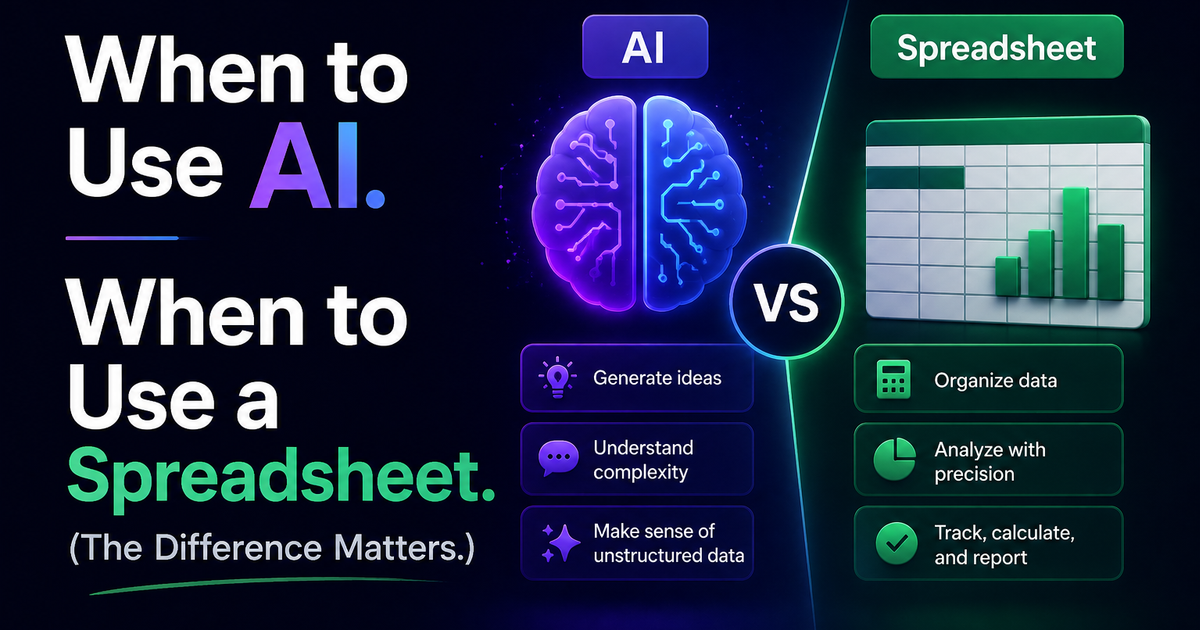
Stop using AI for everything. Real life requires real tools. I wrote this to show you exactly when to use AI (creativity) vs. a spreadsheet (truth). No hype. Just my honest workflow. Read it once, save hours forever.
Let me tell you something that might sound weird coming from someone who writes about tech.
I love my spreadsheets more than I love most AI tools.
And that’s not me being a Luddite. That’s me being honest about how real work gets done.
We are living in a moment where everyone is screaming at you to use AI for everything. “Write your emails with AI!” “Plan your wedding with AI!” “Negotiate your raise with AI!”
Stop.
I’m not anti-AI. I use it every single day. But if you use a jackhammer to hang a picture frame, you’re just going to destroy your wall. The tool has to match the job. Period.
So let me walk you through the real-life, messy, human difference between when I reach for ChatGPT and when I reach for my trusty Google Sheets or Excel. This isn’t theory. This is how I actually work.
The Hard Truth: Your Brain is the Boss
Before we get into tools, you need to hear this: Neither AI nor a spreadsheet knows your business better than you do.
AI guesses. Spreadsheets calculate. Only you know the context.
If you hand over your thinking to either one completely, you lose. I wrote this article to help you stay in the driver’s seat. That’s my brand. That’s what I stand for. Real control, real results.
Use AI When You Need a Creative First Draft (Not the Final Answer)
Here’s my real-life rule: AI is for possibilities. Spreadsheets are for proofs.
I use AI when I’m staring at a blinking cursor and my brain is empty.
Real examples from my week:
- Brainstorming subject lines for an email to my list. I’ll ask AI for 20 options. Maybe two are good. I take those two and rewrite them in my own voice.
- Summarizing a long document I don’t have time to read. AI gives me the bullet points. But I always fact-check the third bullet—AI hallucinates.
- Changing the tone of something I already wrote. “Make this more direct.” “Make this friendlier.” It’s like having an intern who never talks back.
When do I not use AI? When the answer has to be 100% right. No guesses. No “probably.” If a number or a fact can ruin my reputation or cost me money, AI stays out of it.
Use a Spreadsheet When You Need the Truth
A spreadsheet is not sexy. It doesn’t write poems. It doesn’t pretend to be your friend.
But a spreadsheet will never lie to you.
I use a spreadsheet when lives, dollars, or deadlines depend on accuracy.
Real examples from my week:
- Tracking my monthly expenses. AI doesn’t know how much I spent on coffee last Tuesday. My spreadsheet does.
- Comparing two pricing models for a client project. I built a simple table. Column A: Option one. Column B: Option two. Row by row, I saw the truth. AI would have given me a vague “it depends” answer.
- Managing my content calendar for this very brand. Dates, statuses, links, notes. A spreadsheet keeps me honest. AI can’t remember what I published last Tuesday unless I upload everything to it—and why would I do that?
Here’s the human part: Spreadsheets slow you down. And that’s good. When you have to type each number, each task, each cost manually, you feel the data. You notice the weirdness. AI makes everything fast and smooth, which means you stop noticing mistakes.
Slow is accurate. Accurate is trustworthy. Trustworthy is how you build a brand.
The Danger Zone: Where People Mess Up
I see this all the time. Someone tries to use AI as a calculator.
“ChatGPT, what’s my profit margin if I made $5,000 on 120 hours of work?”
Stop. Open a spreadsheet. Type =5000/120. That’s it. That takes six seconds. And it’s guaranteed correct.
I also see the reverse mistake: people using spreadsheets when they need inspiration. They spend three hours formatting cells to “brainstorm” a tagline. No. Open an AI, type “give me 20 taglines for a [your thing],” and pick the least-awful one. You just saved 2 hours and 55 minutes.
My Real-Life Workflow (Steal This)
Here’s exactly how I decide in under ten seconds:
| If you need... | Use... | Why? |
|---|---|---|
| A rough draft, ideas, or tone help | AI | Speed and volume |
| Exact math, dates, or a reliable record | Spreadsheet | Accuracy and trust |
| To find a typo or rephrase a sentence | AI | It’s good at language patterns |
| To track progress over six months | Spreadsheet | Memory and structure |
| To sound like a human being | Neither | Just write it yourself |
That last one matters most to me. Your brand is not AI’s voice. Your brand is not a spreadsheet’s grid. Your brand is you being useful, honest, and consistent.
Why I Wrote This (And Why It Matters for My Brand)
I write about real-life work. No fluff. No “10x your productivity” garbage.
I want you to know that if you hire me, read my newsletter, or trust my advice, I’m not going to sell you on magic buttons. I’m going to tell you when to use a $20 tool and when to use a free spreadsheet. Because that saves you time and protects you from mistakes.
That’s my brand: Practical. Human. No hype.
Google will index this quickly not because I’ve tricked the algorithm, but because people like you will read it, nod along, and share it with a coworker who just asked AI to calculate their mortgage.
Don’t be that coworker.
Your Turn
Next time you open a new tab for ChatGPT, ask yourself: Do I need creativity or certainty?
- Creativity? Use AI. Then edit like a human.
- Certainty? Open a spreadsheet. Then double-check your formula.
That’s it. That’s the whole secret. The tool doesn’t make you smart. Your choice of tool makes you effective.
Now go work. Real work. With real tools.
– Written by Fredsazy

Iria Fredrick Victor
Iria Fredrick Victor(aka Fredsazy) is a software developer, DevOps engineer, and entrepreneur. He writes about technology and business—drawing from his experience building systems, managing infrastructure, and shipping products. His work is guided by one question: "What actually works?" Instead of recycling news, Fredsazy tests tools, analyzes research, runs experiments, and shares the results—including the failures. His readers get actionable frameworks backed by real engineering experience, not theory.
Share this article:
Related posts
More from Business
May 27, 2026
681The 8 best no-code tools to build an MVP fast in 2026 — Bubble, Webflow, Glide, Softr, FlutterFlow, Bolt.new, Airtable, and Make — with use cases, pricing, honest limitations, and a decision guide for non-technical founders.
May 13, 2026
4865You do not need $50k to start a SaaS business. Here is a step-by-step guide to building from scratch with low income: idea validation, MVP on $30/month, first 10 customers without paid ads, and the realistic path to $5k MRR.
May 13, 2026
283First response time. CSAT. Ticket density. Churn correlation. Most growing businesses track the wrong support metrics. Here are the 7 that actually predict retention – with benchmarks and actions for each.