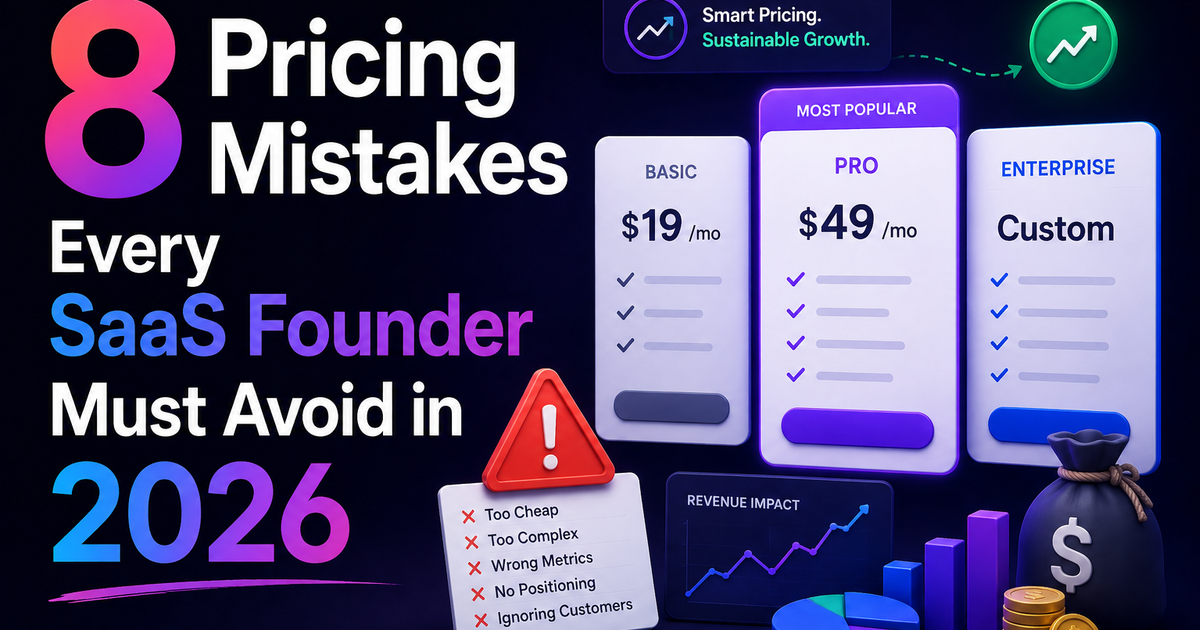
8 Pricing Mistakes Every SaaS Founder Must Avoid in 2026
Most SaaS founders spend 100 hours on product for every 1 hour on pricing. That's backwards. Here are 8 pricing mistakes costing you real money in 2026 – and exactly how to fix each one. No fluff. Just benchmarks and action steps.
You can build the best product in your category. You can have happy customers who tell their friends. You can have a low churn rate and a growing MRR curve.
And you can still go out of business.
Because you priced it wrong.
I have watched this happen more times than I want to admit. A founder with a solid product, a real market, and genuine traction. But their pricing model is slowly strangling them. They don't see it until the cash runway hits two months and the panic sets in.
Here's the painful truth: Most SaaS founders spend 100 hours on their product for every 1 hour on their pricing.
That ratio is backwards.
Pricing is not a "set it and forget it" decision you make during launch week. Pricing is a continuous growth lever. And in 2026, with tighter budgets, AI-native competitors compressing margins, and buyers more price-sensitive than ever, getting pricing wrong is no longer a minor mistake.
It's a fatal one.
This article is about the eight most common pricing mistakes I see SaaS founders make. I have made some of these myself. I have watched others make the rest. Learn from them so you don't repeat them.
What Makes a Pricing Mistake "Deadly"?
Before we get into the list, let me define what I mean by a mistake worth writing about.
A deadly pricing mistake is not "losing a few deals because you're 10% too high."
A deadly pricing mistake is structural. It meets at least one of these tests:
| Test | What It Means |
|---|---|
| It leaves money on the table permanently | You're undercharging customers who would have paid more – and you'll never get that revenue back |
| It increases churn | Your pricing model punishes the wrong behavior or confuses customers into leaving |
| It caps your TAM (Total Addressable Market) | You've priced yourself out of entire customer segments |
| It scales badly | What works at $10k MRR breaks at $100k MRR, forcing a painful migration |
| It signals the wrong value | Your price says "cheap commodity" when your product is actually premium |
If your pricing mistake hits even one of these, it's costing you real money. If it hits two or more, it's a crisis you haven't discovered yet.
Here are the eight mistakes that do the most damage.
Mistake #1: Charging a Single Flat Rate for Everyone
What it looks like:
"One plan. $49/month. Unlimited everything."
Why founders do this:
It feels simple. It feels fair. It feels like a competitive advantage against complicated enterprise plans.
Why it's a mistake:
You are leaving money on the table from two directions simultaneously.
First, small customers who would have paid $29/month are now paying $49. They might churn faster because the price feels high relative to their usage. Or worse – they never sign up at all.
Second, large customers who would have paid $499/month are paying $49. You are subsidizing their heavy usage with your light users. Every time they open a support ticket or consume API calls, you lose money on them.
What actually works:
A graduated model with at least three tiers:
| Tier | Price | Best for |
|---|---|---|
| Basic | $29–49/month | Individuals, freelancers, small teams getting started |
| Pro | $99–199/month | Growing teams with more users and features |
| Enterprise | Custom | Large teams needing SLAs, security, dedicated support |
This captures value at every level. Small customers get an entry point. Large customers pay for what they use. You stop losing money on your best customers.
Real benchmark: Companies using tiered pricing see 2–3x higher revenue per customer than flat-rate companies, according to pricing data from ProfitWell and Price Intelligently.
Mistake #2: Making Your Pricing Impossible to Find
What it looks like:
"Contact sales for pricing." With no ballpark numbers anywhere on your website.
Why founders do this:
They think it creates a "premium" feel. Or they're worried competitors will see their prices. Or they haven't actually decided on pricing yet.
Why it's a mistake:
In 2026, buyers do not have the patience for this.
A potential customer lands on your site. They click "Pricing." They see "Contact us." They close the tab. They go to a competitor who shows prices clearly.
You just lost a deal not because your product was worse – but because your pricing page was a roadblock.
Here's what actually happens when you hide pricing:
| Buyer reaction | % of buyers (2025 data) |
|---|---|
| Leaves immediately | ~40% |
| Books a call but is already skeptical | ~35% |
| Assumes it's too expensive | ~15% |
| Actually books a call in good faith | ~10% |
You are filtering out 40-50% of potential customers before they even try your product. That's not premium positioning. That's self-sabotage.
What actually works:
Show transparent pricing for your self-serve tiers. Put the numbers on the page. For enterprise, show a starting range – "Enterprise plans start at $1,500/month" – so buyers know if they can afford you before they book a call.
The only exception: If your product is genuinely so complex that every deal requires custom pricing (think Palantir, not typical SaaS). For 95% of SaaS companies, that's not you.
Mistake #3: Pricing Based on Cost, Not Value
What it looks like:
"We need a 70% gross margin, so we'll take our hosting costs and add 30%."
Why founders do this:
Costs are easy to measure. Value is hard. So they take the easy path.
Why it's a mistake:
Your customers do not care what your hosting bill is. They care what problem you solve for them.
If your product saves a customer 10 hours per week of manual work, and that work is worth $200/hour in their time, then you are delivering $8,000/month in value. Your hosting costs might be $500. A cost-plus price of $650 is leaving $7,350 on the table.
Meanwhile, a different customer might only save 2 hours per week. The same $650 price might be too high for them.
Cost-plus pricing ignores this completely. It treats every customer the same. Value-based pricing captures the difference.
What actually works:
Calculate value-based pricing using this framework:
- Identify the customer's alternative – What do they do without you? Spreadsheets? A competitor? Manual work?
- Quantify the cost of that alternative – Time, money, errors, frustration.
- Price at 10-20% of the value you deliver – If you save them $10,000/month, charge $1,000-2,000/month.
This is not guesswork. You can learn this by talking to customers who already use your product. Ask them: "If we doubled our price tomorrow, would you stay or leave?" The answer tells you your pricing power.
Mistake #4: No Usage-Based Component in 2026
What it looks like:
Pure per-seat pricing only. Or pure flat-rate only. Nothing that scales with usage.
Why founders do this:
Per-seat is simple. Usage billing is scary to implement.
Why it's a mistake:
In 2026, buyers are allergic to paying for seats they don't use. They have been burned too many times by legacy software that charges for 50 users when only 30 actually log in.
Furthermore, usage-based pricing aligns your incentives with your customers. When they succeed and use your product more, you make more money. That's a healthy relationship.
The data backs this up:
| Metric | Pure per-seat | Hybrid (per-seat + usage) |
|---|---|---|
| Average contract value | Baseline | 2-3x higher |
| Expansion revenue | Difficult | Built-in |
| Customer satisfaction with pricing | Low (paying for unused seats) | High (pay only for what you use) |
What actually works:
A hybrid model:
- Base fee per seat ($20/seat/month for 10 seats = $200)
- Plus usage overage ($0.50 per 1,000 API calls beyond included amount)
- Or plus feature-based usage ($100 per additional project, workspace, or environment)
This captures value from customers who grow without punishing them with unused seats. It's the model that scaled Snowflake, Stripe, and Twilio – for good reason.
Mistake #5: Never Raising Prices (The Silent Killer)
What it looks like:
Your pricing page hasn't changed in 18 months. You launched at $49/month in 2022. It's now 2026. Still $49/month.
Why founders do this:
Fear. Pure fear. Fear that customers will leave. Fear that competitors will undercut you. Fear that the conversation is awkward.
Why it's a mistake:
Everything else goes up. Your hosting costs rise. Your payroll increases. Your product delivers more value than it did at launch. Why is your price frozen in time?
Here's what happens when you never raise prices:
| Year | Price | Customers who joined at $49 | New customers who would pay $79 | Revenue impact |
|---|---|---|---|---|
| 1 | $49 | Pay $49 | N/A | Baseline |
| 2 | $49 | Still pay $49 | Would pay $79 | -$30/mo per new customer |
| 3 | $49 | Still pay $49 | Would pay $99 | -$50/mo per new customer |
You are leaving money on the table from every single new customer. And your oldest customers are getting a discount they never asked for.
What actually works:
Raise prices annually. Target 5-10% for existing customers (with notice). Target market rate for new customers.
The data is clear: 80-90% of customers will accept a reasonable price increase without leaving. The 10-20% who leave were often your least profitable customers anyway – the ones who churn at the first friction.
Do it this way:
- Announce 60-90 days in advance
- Explain why (not defensive – confident: "We're investing more in X, Y, Z")
- Grandfather existing customers for 6-12 months, then transition
- Watch your revenue grow without losing sleep
Mistake #6: No Annual Discount (Leaving Cash on the Table)
What it looks like:
Monthly pricing only. Or annual pricing offered but with no meaningful discount (e.g., "pay annually: $588 vs $49/month" – saves $0).
Why founders do this:
Monthly recurring revenue (MRR) feels good on dashboards. Annual commits are harder to track. Some founders also worry that an annual discount "leaves money on the table."
Why it's a mistake:
Cash upfront is always better than cash later. Always.
A customer who pays $588 annually gives you $588 today. A customer who pays $49 monthly gives you $49 today, then $49 next month, then $49 the month after. If they churn after 4 months, you made $196 instead of $588.
You lost $392. And you got nothing in return for that loss.
Annual plans also reduce involuntary churn (expired credit cards, forgotten subscriptions) and signal commitment from serious customers.
What actually works:
Offer a meaningful annual discount: typically 15-25% off the monthly price.
| Monthly price | Annual price (20% discount) | You get upfront | Customer saves |
|---|---|---|---|
| $49 | $470 ($39.17/mo equivalent) | $470 | $118/year |
| $99 | $950 ($79.17/mo equivalent) | $950 | $238/year |
| $299 | $2,870 ($239.17/mo equivalent) | $2,870 | $718/year |
In return for giving you cash upfront, the customer gets a better effective monthly rate. That's a fair trade.
Make the annual option prominent on your pricing page. Not hidden. Not an afterthought. You will see 20-40% of new customers choose annual when the discount is clear.
Mistake #7: Letting Customers Self-Serve Enterprise Features
What it looks like:
Your "Pro" plan includes everything. Enterprise is just "more seats" and "priority support." The actual features are identical.
Why founders do this:
You want to be "fair." You don't want to gatekeep features behind an expensive plan.
Why it's a mistake:
You are training your largest potential customers to stay on lower tiers forever.
A company with 200 employees that needs SSO, audit logs, and a SLA is not going to pay enterprise pricing if all those features are available on your $199/month Pro plan. Why would they?
They will happily stay on Pro. You will unhappily provide enterprise-level support and compliance features to a customer paying $199/month. You lose money on every support ticket.
What actually works:
Genuine feature differentiation by tier:
| Feature | Basic | Pro | Enterprise |
|---|---|---|---|
| Users | Up to 5 | Up to 50 | Unlimited |
| API calls | 1,000/month | 10,000/month | Custom |
| SSO/SAML | ❌ | ❌ | ✅ |
| Audit logs | ❌ | ❌ | ✅ |
| SLA (99.9% uptime) | ❌ | ❌ | ✅ |
| Dedicated support | ❌ | ❌ | ✅ |
| Custom contract | ❌ | ❌ | ✅ |
Enterprise customers will pay for these features because they need them. Compliance, security, and uptime guarantees are not nice-to-haves for larger companies. They are requirements.
By gating these behind enterprise pricing, you are not being greedy. You are being honest about the cost of delivering those features. And you are creating a natural upgrade path for customers who grow.
Mistake #8: No Free Trial or a Broken One
What it looks like:
No free trial at all. Or a 7-day trial that's too short. Or a free trial that requires a credit card upfront. Or a free trial that gives access to such limited features that customers can't actually evaluate the product.
Why founders do this:
Fear of "tire kickers." Fear of abuse. Fear that a long trial will delay revenue.
Why it's a mistake:
In 2026, a free trial is not a differentiator. It is table stakes. If you don't have one, you are invisible to a huge segment of buyers who refuse to sign up for anything without trying first.
The data on free trials:
| Trial length | Conversion rate | Notes |
|---|---|---|
| No trial | Lowest (<5%) | Only works for very well-known brands |
| 7 days | 10-15% | Too short for most B2B products |
| 14 days | 20-25% | Sweet spot for most SaaS |
| 30 days | 25-30% | Best for complex products with long sales cycles |
Credit card requirements also affect conversion:
| Trial type | Signup rate | Conversion to paid | Net effect |
|---|---|---|---|
| Credit card required | Low (signup friction) | Higher (committed users) | Mixed |
| No credit card required | High (easy signup) | Lower (tire kickers) | Usually better net |
What actually works:
- 14-day free trial for most B2B SaaS
- No credit card required for the first 7 days (ask for card on day 7 to continue)
- Full access to the Pro plan during trial (not a gimped version)
- Onboarding emails during the trial showing key features
- Trial extension option (automated, self-serve) for customers who need more time
The goal is not to prevent "abuse." The goal is to get as many qualified users as possible to experience your product's value. A tiny percentage will abuse any system. Ignore them. Focus on the 95% who are honest.
How These Mistakes Compound (The Real Math)
Let me show you why fixing these mistakes matters. Alone, each mistake might cost you 5-10% of potential revenue. But pricing mistakes compound just like churn.
Consider a SaaS company with:
| Starting point | Value |
|---|---|
| Potential ideal monthly revenue | $100,000 |
| Current actual monthly revenue | $65,000 |
Where did the $35,000 go?
| Mistake | Estimated leakage |
|---|---|
| Flat-rate pricing (no tiers) | -$10,000 |
| No usage-based component | -$8,000 |
| Never raised prices (2+ years) | -$7,000 |
| No annual discount offered | -$5,000 |
| Weak free trial conversion | -$5,000 |
| Total leakage | -$35,000 |
These are not theoretical numbers. I have run audits for founders and found exactly this pattern. The money is not "lost" – it was never captured because the pricing model was poorly designed.
The good news: Every one of these mistakes is fixable. And fixing them does not require months of engineering work or a complete product rewrite. It requires clear thinking, customer conversations, and the courage to change.
Pricing Benchmarks for 2026 (What "Good" Looks Like)
Use this table to evaluate your current pricing model:
| Metric | Poor | Acceptable | Good | Excellent |
|---|---|---|---|---|
| Number of tiers | 1 | 2 | 3 | 3 + custom enterprise |
| Price range (smallest to largest) | 1x | 3-5x | 10x | 20x+ |
| Annual discount offered | 0% | 5-10% | 15-20% | 25%+ |
| Usage-based component | None | Minimal | Hybrid (seats+usage) | Deep usage metering |
| Free trial length | None or 7 days | 14 days | 14-30 days | Flexible |
| Price increase frequency | Never | Every 2 years | Annually | Annually + inflation |
| Self-serve enterprise features | All features in Pro | Some gated | Clear gates | Strategic gates |
| Pricing page transparency | Hidden ("Contact us") | Ranges shown | Full self-serve tiers | Full + enterprise range |
Frequently Asked Questions
How often should I change my pricing?
Not more than once per year for existing customers. But you should test pricing continuously with new customer cohorts. Run A/B tests on your pricing page. Try different price points for 2-4 weeks and measure conversion. What you learn can inform your annual change.
What if a competitor is cheaper?
Lower price is a race to the bottom that you will lose. Compete on value, not price. If your product delivers more, charge more. The customers who only care about price are not your best customers anyway.
How do I grandfather existing customers when raising prices?
Give them 60-90 days notice. Offer to keep their current price for 6-12 months as a courtesy. Most will convert to the new price when the time comes. Those who leave were going to leave eventually anyway.
What's the best way to find our ideal price?
Talk to customers. Ask the "Van Westendorp" questions:
- At what price would this feel too expensive that you wouldn't buy?
- At what price would this feel like a bargain?
- At what price would this feel expensive but you'd still consider?
- At what price would this feel so cheap that you'd doubt quality?
The intersection of these answers gives you your optimal range.
Should we offer a free plan (not just trial)?
Only if your product has a strong network effect (e.g., collaboration tools where free users bring paying users) or if free users cost you nearly nothing. For most B2B SaaS, free plans attract the wrong kind of user and drain support resources. A time-limited free trial is better.
What to Do Tomorrow (Action Steps)
You don't need to fix all eight mistakes this week. That's overwhelming and you have a product to build.
Do this instead:
Week 1: Audit your current pricing against the eight mistakes above. Score yourself honestly (1 = not a problem, 5 = critical problem). Pick the top two mistakes to fix first.
Week 2: For each mistake, write down one specific change. Example: "Add 15% annual discount option." Example: "Add a $99 Pro tier between Basic and Enterprise."
Week 3: Test the change with new customer traffic only. Run it for 14 days. Measure conversion rate, average revenue per customer, and churn.
Week 4: If the test improves metrics, roll it out to all new customers. If not, revert and try a different version.
Repeat this cycle every quarter. Pricing is not a one-time decision. It is a continuous optimization problem.
Why I Wrote This
I am tired of watching good SaaS products fail because of bad pricing.
Not because the product was weak. Not because the market was small. Because the founder was afraid to charge what the product was worth, or didn't know how to structure a pricing model that scales.
Pricing is not a marketing decision. It is not a finance decision. It is a product decision that affects every other part of your business – acquisition, retention, cash flow, valuation, and ultimately, survival.
The mistakes above cost real founders real money every single day. I have seen the bank accounts. I have sat through the painful post-mortems.
Do not let your company be one of them.
Fix your pricing. Charge what you're worth. Build a business that lasts.
– Written by Fredsazy

Iria Fredrick Victor
Iria Fredrick Victor(aka Fredsazy) is a software developer, DevOps engineer, and entrepreneur. He writes about technology and business—drawing from his experience building systems, managing infrastructure, and shipping products. His work is guided by one question: "What actually works?" Instead of recycling news, Fredsazy tests tools, analyzes research, runs experiments, and shares the results—including the failures. His readers get actionable frameworks backed by real engineering experience, not theory.
Share this article:
Related posts
More from Business
May 27, 2026
686The 8 best no-code tools to build an MVP fast in 2026 — Bubble, Webflow, Glide, Softr, FlutterFlow, Bolt.new, Airtable, and Make — with use cases, pricing, honest limitations, and a decision guide for non-technical founders.
May 13, 2026
4872You do not need $50k to start a SaaS business. Here is a step-by-step guide to building from scratch with low income: idea validation, MVP on $30/month, first 10 customers without paid ads, and the realistic path to $5k MRR.

May 13, 2026
285First response time. CSAT. Ticket density. Churn correlation. Most growing businesses track the wrong support metrics. Here are the 7 that actually predict retention – with benchmarks and actions for each.