PostgreSQL vs MongoDB: Which Database Fits Your Project?
PostgreSQL vs MongoDB in 2026 — an honest comparison covering benchmarks, data modelling, ACID transactions, scaling, pgvector vs Atlas Vector Search, pricing, and a decision framework for your project.
The database choice you make at the start of a project will outlast your first programming language, your first framework, and probably your first team. It shapes how you model data, how you query it, how you scale it, and how much pain you accumulate over time as your requirements evolve.
PostgreSQL and MongoDB are the two most debated options for application developers in 2026 — one a relational powerhouse that has spent three decades accumulating capabilities, the other a document-first database built for schema flexibility and horizontal scale. And in 2026, the comparison is more nuanced than it has ever been.
Both databases have been converging. PostgreSQL's JSONB has matured significantly — you can now store, index, query, and transform JSON data with the full power of SQL. MongoDB has added multi-document ACID transactions, cross-collection joins, schema validation, and aggregation operators that mirror SQL functions. Neither database has a monopoly on any single capability anymore.
For 80% of applications being built in 2026, PostgreSQL is the right default. It has absorbed so many capabilities over the past decade — JSONB, full-text search, partitioning, pgvector, logical replication — that the use cases where MongoDB is clearly superior have narrowed significantly. MongoDB remains the better tool for a specific set of problems, and when those problems are yours, it is the obvious choice.
This guide gives you the honest comparison — benchmarks, data models, scaling, AI capabilities, pricing, and a decision framework — so you can choose based on your actual workload rather than assumptions from five years ago.
The fundamental difference: how each database thinks about data
Before benchmarks or features, understand the architectural philosophy of each database — because every other difference flows from this.
PostgreSQL is relational. Data lives in tables with defined schemas. Rows have columns. Relationships between tables are expressed with foreign keys and navigated with joins. The structure is defined before data is inserted, and that structure enforces consistency. Change the structure later and you run migrations.
-- PostgreSQL: structured, relational
CREATE TABLE users (
  id          SERIAL PRIMARY KEY,
  email       TEXT NOT NULL UNIQUE,
  name        TEXT NOT NULL,
  created_at  TIMESTAMPTZ DEFAULT NOW()
);

CREATE TABLE orders (
  id         SERIAL PRIMARY KEY,
  user_id    INT REFERENCES users(id),
  total      DECIMAL(10,2) NOT NULL,
  status     TEXT NOT NULL,
  created_at TIMESTAMPTZ DEFAULT NOW()
);

-- Retrieve a user and all their orders
SELECT u.name, u.email, o.total, o.status
FROM users u
JOIN orders o ON o.user_id = u.id
WHERE u.id = 123;
MongoDB is document-oriented. Data lives in collections as JSON-like documents (stored as BSON). Each document can have a different structure — no predefined schema required. Related data is often embedded inside a single document rather than spread across multiple tables.
// MongoDB: flexible, document-oriented
db.users.insertOne({
  email: "jane@example.com",
  name: "Jane Smith",
  createdAt: new Date(),
  orders: [                          // Orders embedded directly in the user document
    { total: 149.99, status: "shipped" },
    { total: 89.00,  status: "processing" }
  ]
});

// Retrieve a user and their orders in one query — no join needed
db.users.findOne({ email: "jane@example.com" });
This difference is not just syntactic. It reflects two fundamentally different ways of thinking about data:
- PostgreSQL says: define your data structure upfront, enforce relationships at the database level, use queries to navigate those relationships
- MongoDB says: store data in the shape your application already uses, embed related data together, evolve the structure as your application evolves
Every trade-off in this comparison flows from this architectural decision.
Performance: what the 2026 benchmarks actually show
The most surprising finding in 2026 benchmarks: PostgreSQL's JSONB is 3.7x faster than MongoDB for JSON queries. The document database got out-documented by a relational database with JSON extensions. This performance gap comes from PostgreSQL's JSONB indexing and sophisticated query planner.
PostgreSQL wins on joins (45ms vs 380ms) and complex queries. MongoDB wins on horizontal scaling.
Here's the full performance picture:
Where PostgreSQL wins:
Complex queries with joins: PostgreSQL at 45ms vs MongoDB at 380ms — an 8x advantage. For any application that needs to correlate data across entity types, SQL's advantage is decisive.
JSON queries: PostgreSQL JSONB is 3.7x faster than MongoDB for JSON-heavy workloads. Counter-intuitive but documented in multiple 2026 benchmarks.
Analytical queries: For aggregations, GROUP BY operations, window functions, and complex analytical workloads, PostgreSQL's query planner consistently outperforms MongoDB's aggregation pipeline.
Storage efficiency: PostgreSQL uses approximately 55% less disk space than MongoDB for equivalent datasets — meaningful at scale.
Where MongoDB wins:
Write throughput: MongoDB delivers 45,000 concurrent write operations per second versus PostgreSQL's 32,000, a 40% advantage. For time-series data like IoT sensors, MongoDB handles 45,000–65,000 writes per second compared to PostgreSQL's 30,000–50,000. MongoDB 9.0 extended this lead with 56% faster bulk writes and 20% faster concurrent writes compared to version 7.0.
Single-document reads: Document-native operations show similarly low latency: 0.09 milliseconds for nested document reads versus PostgreSQL's 0.14ms. When data is pre-embedded in a single document and no joins are needed, MongoDB's retrieval is faster.
Horizontal write scaling: MongoDB's native sharding distributes writes across multiple nodes seamlessly. PostgreSQL's horizontal scaling requires Citus or similar extensions and is more complex to operate.
The bottom line: Choose based on your query patterns, not raw speed. If your application does simple document reads and writes, both perform similarly. If you run complex analytical queries, PostgreSQL is faster. If you need to scale writes horizontally across many servers, MongoDB's sharding gives it an advantage.
Data modelling: relational vs document
The database you choose determines how you model your data — and getting the data model right has more long-term impact on your application than any performance benchmark.
The PostgreSQL approach: normalise and relate
PostgreSQL encourages normalisation — breaking data into its smallest meaningful units, storing each unit once, and expressing relationships explicitly.
-- Normalised schema: each concept has its own table
CREATE TABLE products (
  id          SERIAL PRIMARY KEY,
  name        TEXT NOT NULL,
  base_price  DECIMAL(10,2) NOT NULL
);

CREATE TABLE product_variants (
  id          SERIAL PRIMARY KEY,
  product_id  INT REFERENCES products(id),
  size        TEXT,
  colour      TEXT,
  sku         TEXT UNIQUE,
  price_delta DECIMAL(10,2) DEFAULT 0
);

CREATE TABLE inventory (
  variant_id  INT REFERENCES product_variants(id),
  warehouse   TEXT NOT NULL,
  quantity    INT NOT NULL DEFAULT 0,
  PRIMARY KEY (variant_id, warehouse)
);
Benefits: No data duplication. Referential integrity enforced at the database level. Easy to update a product name in one place and have it reflected everywhere. Complex queries across all three tables are fast and straightforward.
Costs: Requires schema planning upfront. Adding a new attribute (like material_type) requires an ALTER TABLE. Joining multiple tables for common queries adds latency compared to pre-embedded documents.
The MongoDB approach: embed and denormalise
MongoDB encourages embedding related data inside a single document, optimised for the access patterns your application actually uses.
// Denormalised document: everything needed for a product page in one place
{
  _id: ObjectId("..."),
  name: "Running Shoe",
  base_price: 120.00,
  variants: [
    {
      sku: "RS-BLK-10",
      size: 10,
      colour: "black",
      price_delta: 0,
      inventory: { main_warehouse: 45, west_coast: 12 }
    },
    {
      sku: "RS-RED-9",
      size: 9,
      colour: "red",
      price_delta: 5.00,
      inventory: { main_warehouse: 8, west_coast: 0 }
    }
  ],
  // Different products can have completely different attributes
  materials: { upper: "mesh", sole: "rubber" },
  certifications: ["OEKO-TEX", "vegan"]
}
Benefits: A product page loads with a single query. No joins. Documents for different products can have completely different structures — shoes have size and colour, electronics have voltage and warranty_years. Schema changes are additive and don't require migrations across existing documents.
Costs: Data duplication (a product name stored in multiple documents). Updating a shared value requires updating multiple documents. Complex queries across documents require $lookup (MongoDB's join equivalent), which is slower than PostgreSQL's native joins.
PostgreSQL's secret weapon: JSONB
Here's what changed the comparison in 2026: PostgreSQL's JSONB column type lets you store and query flexible JSON alongside your structured relational data — with the full power of the SQL query planner.
-- PostgreSQL: structured columns + flexible JSON in the same table
CREATE TABLE products (
  id         SERIAL PRIMARY KEY,
  name       TEXT NOT NULL,
  price      DECIMAL(10,2) NOT NULL,
  attributes JSONB          -- Flexible, schema-free attributes per product type
);

-- Index a specific JSON path for fast queries
CREATE INDEX idx_products_material ON products USING GIN (attributes);

-- Query by JSON attribute with full SQL support
SELECT name, price, attributes->>'material' AS material
FROM products
WHERE attributes @> '{"certifications": ["vegan"]}'
  AND price < 150;
For many teams, this eliminates the need for a separate document database. You get schema flexibility where you need it and relational structure where you need that. PostgreSQL's JSONB handling gives you both without running two databases.
ACID transactions: where the gap used to be, and where it is now
Historically, MongoDB's lack of multi-document ACID transactions was a major limitation for applications requiring consistency across related data. That gap has largely closed.
PostgreSQL has supported full ACID transactions since its first release. Every multi-statement operation is atomic by default. Serialisable isolation prevents phantom reads and write skew. This is battle-tested, production-reliable, and exactly what financial and healthcare applications require.
-- PostgreSQL: multi-table atomic transaction
BEGIN;
  UPDATE accounts SET balance = balance - 500 WHERE id = 1;
  UPDATE accounts SET balance = balance + 500 WHERE id = 2;
  INSERT INTO transfer_log (from_id, to_id, amount) VALUES (1, 2, 500);
COMMIT;
-- Either all three succeed or all three roll back. Always.
MongoDB added multi-document ACID transactions in version 4.0 (2018) and has steadily improved their performance and reliability since. MongoDB 8.0 and 9.0 brought significant transaction performance improvements.
// MongoDB: multi-document transaction (available since 4.0)
const session = client.startSession();
session.startTransaction();
try {
  await accounts.updateOne(
    { _id: 1 },
    { $inc: { balance: -500 } },
    { session }
  );
  await accounts.updateOne(
    { _id: 2 },
    { $inc: { balance: 500 } },
    { session }
  );
  await session.commitTransaction();
} catch (err) {
  await session.abortTransaction();
}
Practical verdict: For applications that need consistent transactions across multiple records — financial systems, inventory management, order processing, healthcare records — PostgreSQL's ACID story is more mature and operationally simpler. MongoDB's transactions work, but they add overhead compared to single-document operations and require explicit session management.
For applications where most operations are single-document reads and writes, MongoDB's transaction overhead is rarely a concern.
Scaling: horizontal vs vertical
MongoDB was built for horizontal scaling from the start. Sharding is a first-class feature. You define a shard key, MongoDB distributes documents across shards automatically, and the mongos router handles query distribution transparently. Adding capacity means adding shards — the application doesn't change.
MongoDB Atlas offers a serverless tier that auto-scales compute and storage. You pay per operation ($0.10 per million reads in 2026). For low-traffic or bursty workloads, this eliminates capacity planning entirely.
PostgreSQL scales vertically with exceptional efficiency — more CPU, more RAM, faster storage, and PostgreSQL handles significantly more load. Horizontal scaling exists through Citus (distributed PostgreSQL), read replicas, and partitioning — but it requires more configuration than MongoDB's native sharding.
Neon's serverless PostgreSQL lets you spin up database branches for development, preview environments, and testing. The serverless compute scales to zero when idle, cutting costs for staging environments to near zero.
The 2026 scaling reality: Most applications at startup and growth stage (under 100GB of data, under 10,000 requests per second) are well within PostgreSQL's vertical scaling capacity without any sharding complexity. MongoDB's horizontal scaling advantage is most valuable at the extreme end of write throughput requirements — IoT data ingestion, high-volume event streaming, content platforms with millions of daily writes.
AI and vector search: the 2026 differentiator
If there's one development that has most significantly tilted the comparison in 2026, it's vector search for AI applications.
If there is a single development that has tilted the PostgreSQL-vs-MongoDB comparison most dramatically, it is pgvector. In 2026, every non-trivial application is either using vector search or evaluating it. RAG pipelines, semantic search, recommendation engines, anomaly detection — embeddings are everywhere. PostgreSQL with pgvector gives you something no other database can match: relational + document + vector search in a single database, with full ACID compliance.
-- PostgreSQL + pgvector: store and query embeddings alongside your data
CREATE TABLE articles (
  id        SERIAL PRIMARY KEY,
  title     TEXT NOT NULL,
  content   TEXT NOT NULL,
  embedding VECTOR(1536)  -- OpenAI text-embedding-3-small dimension
);

CREATE INDEX ON articles USING ivfflat (embedding vector_cosine_ops);

-- Semantic search: find the 5 most similar articles to a given embedding
SELECT title, content,
       1 - (embedding <=> '[0.1, 0.2, ...]'::vector) AS similarity
FROM articles
ORDER BY embedding <=> '[0.1, 0.2, ...]'::vector
LIMIT 5;
MongoDB Atlas Vector Search is a capable product, but it is a separate search index layer bolted onto the document store. PostgreSQL's pgvector is integrated into the query planner — the optimiser understands vector indexes the same way it understands B-tree indexes, and it can combine them in a single execution plan. For AI-powered applications in 2026, this integration is a decisive advantage.
For teams building RAG pipelines, semantic search, or any AI feature that needs vector embeddings alongside operational data, PostgreSQL + pgvector is now the default architecture. You avoid the complexity and cost of running a separate vector database entirely.
Extensions: PostgreSQL's deepest moat
PostgreSQL's ecosystem in 2026 covers almost every use case. Extensions like TimescaleDB (time-series), pgvector (AI embeddings), PostGIS (geospatial), and Citus (distributed) turn it into a specialised database for virtually any workload.
| Extension | What it adds |
|---|---|
| pgvector | Vector similarity search for AI/embedding workloads |
| TimescaleDB | Time-series optimised tables, automatic partitioning, compression |
| PostGIS | Full geospatial support — points, polygons, spatial indexes, GIS queries |
| Citus | Horizontal sharding and distributed queries across multiple nodes |
| pg_partman | Automatic table partitioning by time or range |
| pgcrypto | Encryption functions for sensitive data |
| pg_trgm | Trigram-based fuzzy text search |
| HyperLogLog | Probabilistic cardinality estimation for analytics |
This extension ecosystem is unique to PostgreSQL. A single PostgreSQL instance can handle your transactional data, JSON documents, time-series metrics, geospatial queries, and AI embedding search — without running five different databases.
Managed services and pricing
MongoDB Atlas is the gold-standard managed MongoDB service. Automatic sharding, backups, monitoring, and global multi-region clusters. The free tier is generous for development.
PostgreSQL managed options are more numerous, with fierce competition driving innovation and prices down:
- Supabase — PostgreSQL + Auth + Storage + Realtime. Increasingly popular for startups
- Neon — Serverless PostgreSQL with branching (like Git branches for your database)
- AWS RDS / Aurora — Enterprise-grade with excellent reliability
- Google Cloud SQL / AlloyDB — Strong for GCP-based architectures
- Railway, Render, Fly.io — Developer-friendly options for smaller projects
Pricing comparison at 10,000 queries per second:
RDS PostgreSQL from ~$350/month vs MongoDB Atlas from ~$450/month at 10K QPS. PostgreSQL's managed options are generally more price-competitive at equivalent scale, partly because of the competitive market for PostgreSQL hosting.
Licensing note: MongoDB uses the Server Side Public License (SSPL), which restricts hosting MongoDB as a service without open-sourcing your own infrastructure. PostgreSQL uses the PostgreSQL License — a permissive, BSD-like open-source license with no commercial restrictions. If you're building a hosted database service or embedding MongoDB in a SaaS product, review the MongoDB license terms carefully. PostgreSQL's license has no such restrictions.
Who uses what in production
PostgreSQL: Apple, Instagram, Skype, Twitch, Spotify, Reddit, GitHub. Chosen for transactional consistency, complex query capability, and long-term operational reliability. PostgreSQL's position as the developer community's most-used database — 55.6% of developers choose it as their primary database — reflects its versatility across application types.
MongoDB: eBay, Uber, Lyft, Adobe, Bosch. Chosen primarily for high-volume write throughput, variable document structures, and native horizontal scaling. Most successful MongoDB deployments are concentrated in content management, IoT data ingestion, and event-driven architectures.
Side-by-side comparison
| Dimension | PostgreSQL | MongoDB |
|---|---|---|
| Data model | Relational (tables, rows) + JSONB | Document (JSON/BSON) |
| Schema | Defined upfront, enforced | Flexible, schema-free by default |
| Query language | SQL | MongoDB Query API (MQL) |
| ACID transactions | Full, since v1 | Multi-document, since v4.0 |
| Join performance | 45ms (native) | 380ms ($lookup) |
| JSON query speed | 3.7x faster than MongoDB | Baseline |
| Write throughput | 32,000 ops/sec | 45,000 ops/sec (40% faster) |
| Horizontal scaling | Citus (complex) | Native sharding (built-in) |
| Vector search | pgvector (integrated) | Atlas Vector Search (separate layer) |
| Time-series | TimescaleDB extension | Time-series collections |
| Geospatial | PostGIS extension | Built-in 2D/2DSphere indexes |
| Storage efficiency | 55% less than MongoDB | Higher storage footprint |
| Managed options | Many (Supabase, Neon, RDS, Aurora) | Atlas (primary) |
| Pricing (10K QPS) | ~$350/month | ~$450/month |
| License | PostgreSQL (permissive, no restrictions) | SSPL (restrictions for SaaS hosting) |
| Developer adoption | 55.6% primary database | ~26% |
| New projects (2026) | 3:1 ratio vs MongoDB |
Decision framework: which one for your project?
Choose PostgreSQL if:
- Your data is relational — users have orders, orders have items, items have categories
- You need ACID transactions across multiple records without complexity — financial systems, inventory, healthcare
- You want vector search for AI features without adding another database (pgvector)
- Your queries involve joins — any time you need to correlate data across entity types
- You want the broadest extension ecosystem — time-series, geospatial, distributed, all in one system
- Storage efficiency matters at scale (55% less disk than MongoDB)
- You want SaaS-friendly licensing with no commercial restrictions
- Your team knows SQL — the most transferable database skill in the industry
- You want one database that handles most things well rather than specialised tools
Choose MongoDB if:
- Your data is genuinely document-oriented — every record can have a completely different structure
- You need native horizontal sharding from day one and don't want to manage Citus
- You're building with Node.js/JavaScript and want native JSON ergonomics end-to-end
- You're ingesting high-volume writes — IoT telemetry, event streams, logging — where MongoDB's 40% write throughput advantage matters
- Your schema changes frequently and unpredictably — active exploration phase where migrations would slow you down
- You're building a content management system where articles, products, and pages have wildly different attribute sets
- Your team is already experienced in MongoDB and the switching cost outweighs the technical trade-offs
Consider both if:
In 2026, many teams use both. Postgres handles transactional data — users, orders, payments — where relationships and consistency matter. MongoDB handles content, logs, events, and catalogue data where schema flexibility and write throughput matter. This isn't architecture astronautics — it's matching tools to workloads.
The honest 2026 verdict
If you can only pick one, Postgres is the safer default. It handles 90% of application workloads well, has a larger ecosystem of tools and extensions, and its JSONB support covers many cases where you'd otherwise reach for MongoDB.
The choice that made sense in 2015 — "relational data needs PostgreSQL, document data needs MongoDB" — has been complicated by a decade of both databases borrowing from each other. PostgreSQL now handles documents better than most document databases. MongoDB now handles transactions better than early-generation NoSQL.
The best database is almost always the one your team already knows well, is already running in production, and already has operational procedures for. Choose deliberately, invest in understanding the trade-offs deeply, and resist the pull of the latest database trend unless you have a concrete technical reason to switch.
For a brand-new project with no existing commitment: start with PostgreSQL. Use JSONB where you need schema flexibility. Add pgvector when you build AI features. Reach for MongoDB only when a specific workload has a concrete requirement that PostgreSQL genuinely can't meet as well — primarily native horizontal sharding for massive write throughput, or a data model that's purely document-oriented with no relational requirements.
Frequently asked questions
Is PostgreSQL or MongoDB better for beginners? Both have solid documentation and strong communities. PostgreSQL requires learning SQL, which has a moderate learning curve but is the most transferable skill in the database world. MongoDB's JSON-like query syntax feels more natural to JavaScript developers. For beginners without existing SQL knowledge building with Node.js, MongoDB's initial ergonomics are slightly easier. For everyone else, or for anyone who expects to work with databases long-term, learning SQL via PostgreSQL pays higher dividends.
Can PostgreSQL store JSON like MongoDB?
Yes, and in 2026 it's faster. PostgreSQL's JSONB column type stores JSON in a binary format that supports full indexing, the complete SQL query power, and — according to 2026 benchmarks — JSON query performance 3.7x faster than MongoDB. For most teams that chose MongoDB for "JSON flexibility," PostgreSQL with JSONB now covers that need without sacrificing relational capabilities.
Which database is better for AI applications in 2026? PostgreSQL with pgvector is the default choice for AI-powered applications in 2026. pgvector integrates vector similarity search directly into the PostgreSQL query planner — you can join vector searches with relational queries in a single execution plan, with full ACID compliance. MongoDB Atlas Vector Search exists and works, but it's a separate search index layer rather than a native query planner integration.
Is MongoDB still relevant in 2026? Yes — for the right use cases. MongoDB 9.0 extended its write throughput advantage (56% faster bulk writes vs version 7.0), and its native horizontal sharding remains superior to PostgreSQL's options. For high-volume write workloads, genuinely variable document structures, and Node.js-centric stacks, MongoDB is still the better tool. The use cases where it's the clearly superior choice have narrowed, but they haven't disappeared.
What is MongoDB's SSPL license and should it concern me? The Server Side Public License (SSPL) requires anyone offering MongoDB as a cloud service to open-source their entire infrastructure stack. For teams running MongoDB internally or in their own application, it has no practical impact. For teams building a SaaS product that hosts MongoDB for customers, consult legal counsel — the SSPL's scope is deliberately broad. PostgreSQL's permissive license has no such concerns.
How do I migrate from MongoDB to PostgreSQL?
Migration requires mapping MongoDB's document model to PostgreSQL's relational or JSONB model. Documents with consistent structure map cleanly to normalised tables. Highly variable documents map to a combination of structured columns and JSONB for flexible attributes. Tools like pgloader, AWS Database Migration Service, and Airbyte support MongoDB-to-PostgreSQL migration with varying degrees of automation. The data migration itself is often less challenging than updating application queries from MQL to SQL.
Which should I choose for a startup with uncertain requirements? PostgreSQL. Its JSONB support lets you start without a rigid schema where needed, its extension ecosystem gives you a path to AI features (pgvector), time-series (TimescaleDB), and geospatial (PostGIS) without adding infrastructure, and its permissive licensing means you'll never hit a wall if you decide to offer database hosting to your customers. The "uncertain requirements" argument used to favour MongoDB's schema flexibility — PostgreSQL's JSONB largely neutralises that advantage.

Iria Fredrick Victor
Iria Fredrick Victor(aka Fredsazy) is a software developer, DevOps engineer, and entrepreneur. He writes about technology and business—drawing from his experience building systems, managing infrastructure, and shipping products. His work is guided by one question: "What actually works?" Instead of recycling news, Fredsazy tests tools, analyzes research, runs experiments, and shares the results—including the failures. His readers get actionable frameworks backed by real engineering experience, not theory.
Share this article:
Related posts
More from Software
May 27, 2026
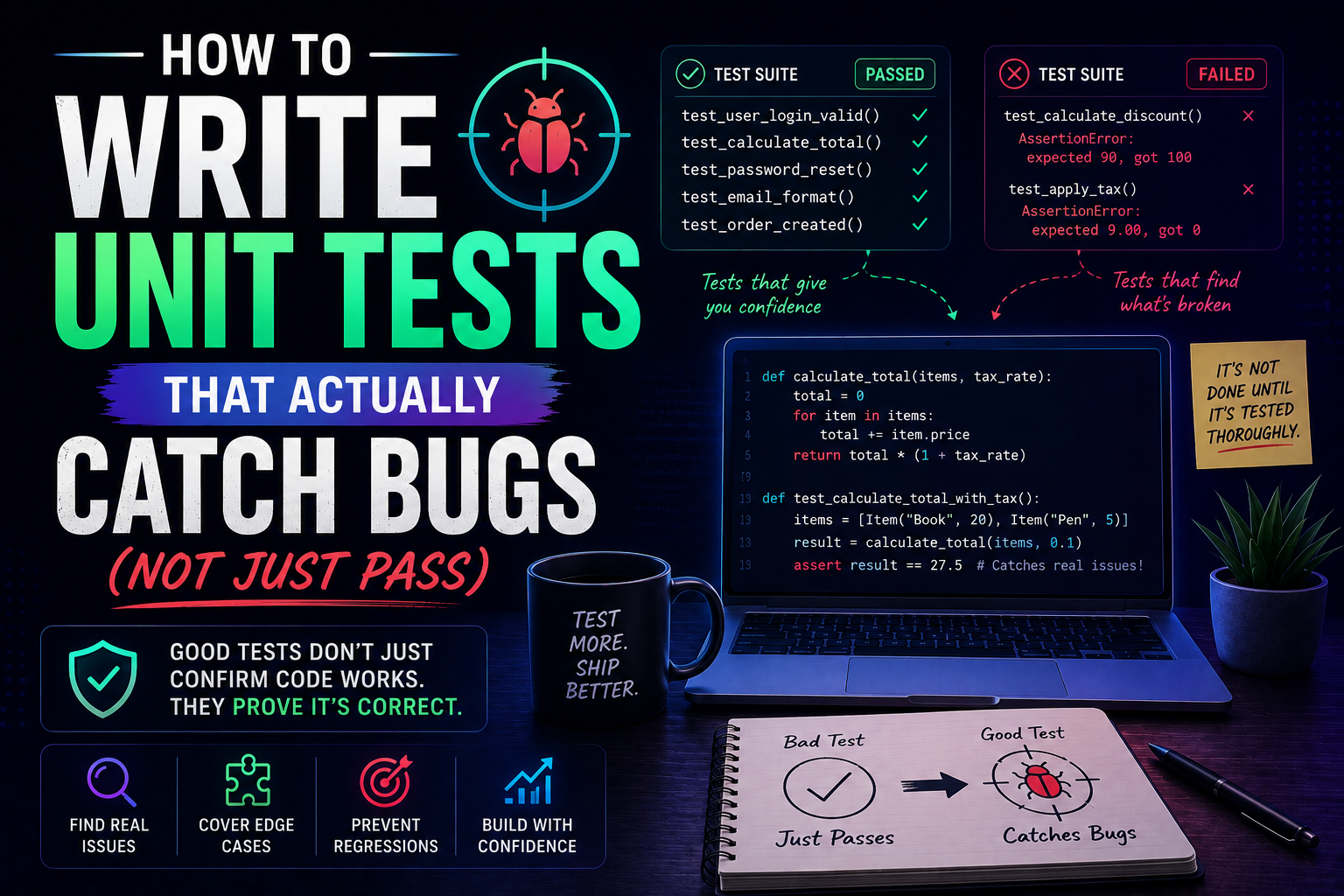
284Learn how to write unit tests that actually catch bugs — not just pass. Covers the AAA pattern, behaviour vs implementation testing, edge cases, test doubles, mutation testing, and a pre-commit checklist for writing tests that protect production.
May 22, 2026
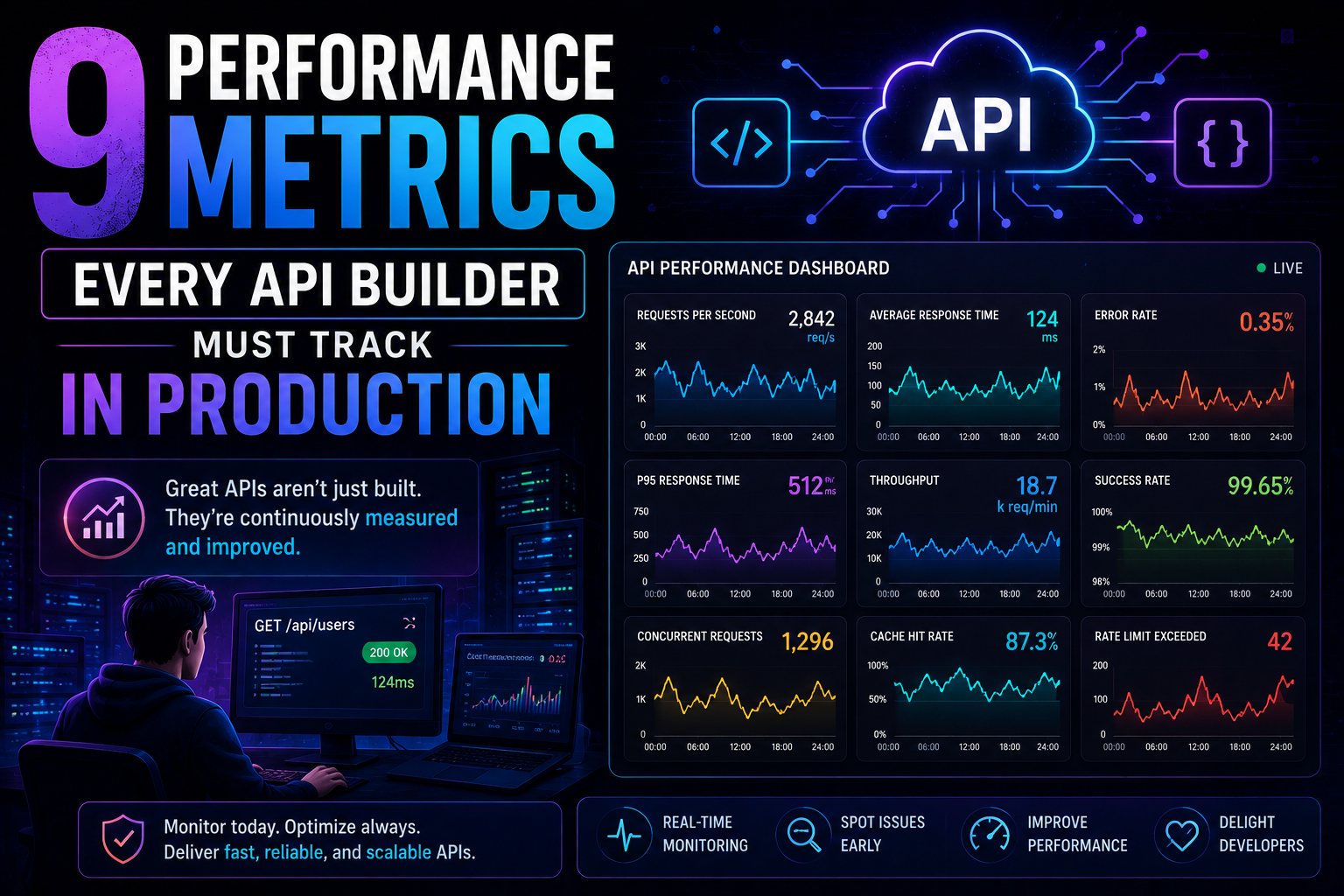
332Latency percentiles. Dependency health. Connection pool saturation. Idempotency success. 9 production metrics every API builder needs – with benchmarks, alert thresholds, and real-world failures prevented.
May 13, 2026
275SQL injection, no rate limiting, mass assignment – 7 security holes I still see in production APIs. Each takes under an hour to fix. Fix them before launch, not after the breach. Real code examples. Real checklist.