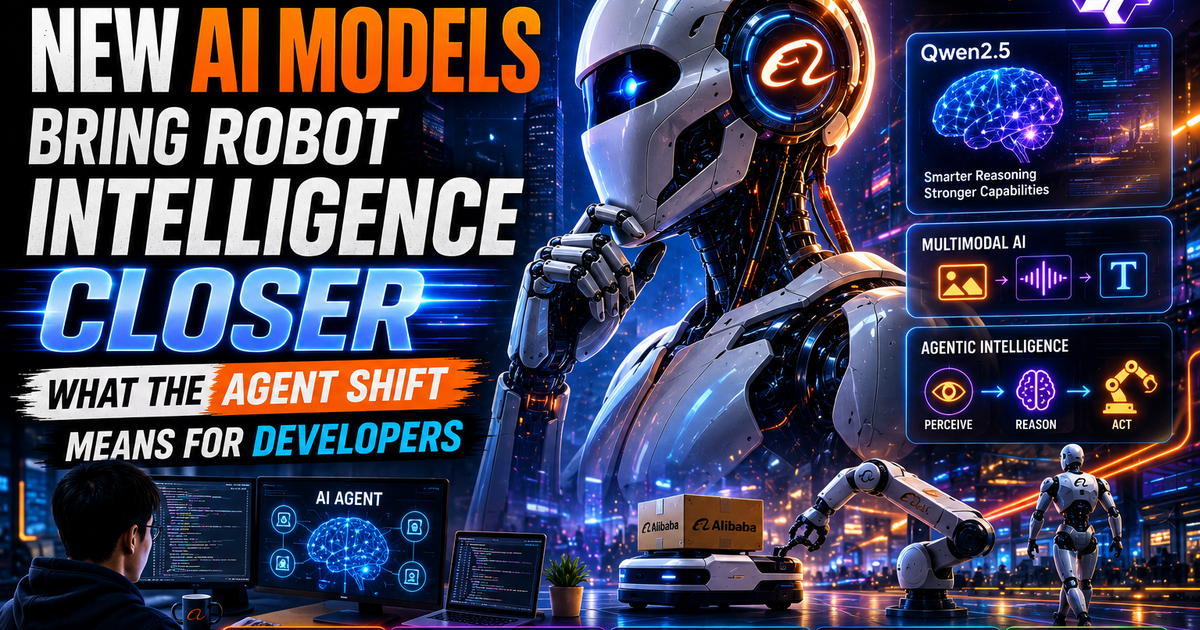
Alibaba's New AI Models Bring Robot Intelligence Closer — What the Agent Shift Means for Developers
Alibaba unveiled the Qwen Robot Suite on June 16 — three AI models for robot navigation, world simulation, and physical manipulation. Here's what the announcement means for developers and the broader agent shift.
Alibaba just made its most significant move yet into physical AI.
The Chinese tech giant unveiled the Qwen Robot Suite on Tuesday — its first dedicated set of AI models built specifically for robots. The announcement marks a deliberate pivot away from conversational chatbots and toward intelligent machines that can perceive, reason, and act in the physical world. Developed by Alibaba's AI research unit Tongyi Lab, the suite has already entered pilot testing with selected Alibaba Cloud enterprise clients.
The timing is not accidental. China's entire tech industry is accelerating its shift from chatbots — which dominated headlines in 2023 and 2024 — to AI agents and embodied intelligence, which are seen as the more lucrative and strategically important frontier for 2026 and beyond.
What the Qwen Robot Suite Actually Is
The suite splits robot intelligence into three interconnected layers, each handling a different challenge that has traditionally held robotics back:
Qwen-RobotNav is a vision-language navigation model. It is designed to help machines understand and move through physical spaces — reading environments the way a person would and planning movement accordingly.
Qwen-RobotWorld is a video "world model" that lets robots simulate how physical scenes will evolve before they act. Instead of reacting to what is happening, the robot can predict what is about to happen and prepare. This kind of predictive capability significantly reduces the error rate in complex manipulation tasks.
Qwen-RobotClaw handles physical manipulation — the fine motor reasoning needed to pick up, move, and interact with objects in the real world.
Together, the three models form a stack that addresses the perception-reasoning-action loop that is the fundamental challenge of embodied AI.
Why This Is Bigger Than One Product Launch
The announcement connects to a broader pattern that has been building all year.
In February, Alibaba's DAMO Academy unveiled RynnBrain — an embodied AI model designed to give robots spatiotemporal memory, allowing machines to recall where objects were, predict how they will move, and reduce errors during complex tasks. At the time, Alibaba claimed the model set 16 benchmark records, outperforming teams from Google and NVIDIA on specific robotics evaluations.
In April, Alibaba's mapping unit Amap revealed it was preparing to launch its first embodied robot — a quadruped — whose underlying models (ABot-M0 for manipulation and ABot-N0 for navigation) had already topped two international benchmarks, the AGIbot World Challenge and World Arena.
And in May, at the Alibaba Cloud Summit in Hangzhou, the company announced Qwen3.7-Max — a flagship language model that can sustain autonomous agent operation for up to 35 hours without performance degrading, executing over 1,000 tool calls in a single run. That model is now positioned as the reasoning backbone for the robot suite.
Taken together, Tuesday's announcement is not an isolated product launch. It is the public face of a coordinated AI-to-robotics strategy that Alibaba has been building across multiple divisions for the better part of a year.
The Competitive Context
Alibaba is not moving in a vacuum. The race to define what the agent era looks like — and who controls the models that power physical machines — is intensifying on multiple fronts simultaneously.
In the US, NVIDIA has been testing humanoid robots in live logistics environments. Google, through DeepMind's robotics work, is pursuing similar embodied intelligence goals. OpenAI has been investing in physical AI companies. The underlying bet from every major lab is the same: the next platform shift in AI is not a better chatbot, it is a machine that can operate in the physical world.
China has a structural advantage in this race that is easy to underestimate. Chinese manufacturers already hold real strengths in hardware production and supply chain. Pairing a domestic model stack — built on Qwen — with that manufacturing base creates a vertically integrated capability that is harder for software-only rivals to replicate. It also aligns directly with national strategic priorities that treat both AI and robotics as areas of geopolitical importance.
Alibaba is also racing its domestic competitors. Baidu, ByteDance, Tencent, and a wave of robotics startups — including X Square Robot, which Alibaba Cloud led a $100 million investment round into — are all pursuing the same territory. The winner is not just a product winner. It is likely to set the standard that Chinese industrial robotics runs on for the next decade.
What Developers Should Pay Attention To
For developers building on AI infrastructure, the Qwen Robot Suite announcement carries a few specific signals worth tracking:
Agent harness compatibility is becoming a competitive spec. Qwen3.7-Max — the model underlying the robot suite — is documented to work with Claude Code, OpenClaw, Hermes Agent, and other popular agent frameworks via both OpenAI-compatible and Anthropic-compatible API specs. This means developers already running agent workflows can route tasks to Alibaba's models without rewriting their infrastructure. Model interoperability is no longer a nice-to-have — it is a go-to-market requirement.
The 35-hour autonomous run claim is the number to watch. Alibaba says Qwen3.7-Max can operate continuously for up to 35 hours without performance degrading. That claim has not been independently verified as of this writing — the figures are vendor-stated. But if it holds up in third-party evaluation, it represents a meaningful advance over most current agent systems, which tend to drift or degrade over long task horizons. Durability at scale is the unsolved problem for production agent deployment.
Embodied AI is now a mainstream product category, not a research project. The Qwen Robot Suite entering enterprise pilot testing — rather than staying in the lab — is the signal that the gap between robotics demo and robotics deployment is closing. For developers building in adjacent spaces (warehouse automation, logistics software, manufacturing tooling), the infrastructure for AI-driven physical systems is arriving faster than most roadmaps anticipated.
The Open Question
The honest caveat on every robotics announcement is the same one it has always been: the gap between a controlled demonstration and a reliable deployed machine has humbled many well-resourced teams.
Alibaba's benchmark results are self-reported. The pilot testing is with selected enterprise clients under controlled conditions. Whether the Qwen Robot Suite translates from demonstrated capability to deployed products at meaningful scale — in warehouses, logistics centres, and eventually homes — is a question that will be answered over the next 12 to 24 months, not today.
What is not in question is the direction. The era of AI that only lives on a screen is ending. The race now is for the machines that move.

Iria Fredrick Victor
Iria Fredrick Victor(aka Fredsazy) is a software developer, DevOps engineer, and entrepreneur. He writes about technology and business—drawing from his experience building systems, managing infrastructure, and shipping products. His work is guided by one question: "What actually works?" Instead of recycling news, Fredsazy tests tools, analyzes research, runs experiments, and shares the results—including the failures. His readers get actionable frameworks backed by real engineering experience, not theory.
Share this article:
Related posts
More from Technews
June 17, 2026
159Europe's push for AI independence dominates this week's G7 summit and VivaTech conference, following new US restrictions on Anthropic's models. Here's what the sovereignty debate means for AI infrastructure decisions everywhere.
June 17, 2026
167Cyber extortion group FulcrumSec claims it stole 1.3TB of data from Novo Nordisk after a failed $25 million ransom demand. Here's what was allegedly taken, how the negotiation unfolded, and why pharma and AI data are becoming prime targets.